A Unique Museum that saves history, inspires the future, depth and gives to the present..
THOMPSON, THOMAS (1933–1982). Thomas (Tommy) Thompson, journalist and writer, the son of Clarence and Ruth Thompson, was born on October 3, 1933, at Fort Worth, Texas. His father was a high school principal and his mother a teacher. After graduating from Arlington Heights High School, Thompson earned a journalism degree from the University of Texas at Austin in 1955. He had started his own newspaper at age eight; by age twenty-three he was city editor of the Houston Press. Around 1958 he married Joyce Alford; they divorced in 1969. He joined Life magazine in 1961 and became an editor and staff writer. When Life ceased publication in 1972, Thompson turned to writing freelance magazine articles and books. His first two books-Hearts (1971), on the rivalry between Houston surgeons Michael DeBakey and Denton Cooley at the dawn of the heart transplant era, and Richie (1973), the story of a Long Island man who killed his drug-addicted son-were based on stories that first appeared in Life. While doing research in Houston for Hearts, Thompson heard a story that inspired his most successful book, Blood and Money (1976). It was based on a true story of scandal and murder among Houston's social elite and involved the deaths of Joan Robinson Hill and her husband, Dr. John Hill, who was accused of her murder before he himself was killed by an alleged hit man. The book made Thompson a millionaire and the target of three libel suits. It sold four million copies in fourteen languages. Thompson said that he wanted to write about the psyche of Texas as reflected in this case, since he felt that it was still a frontier state and its violence had always concerned him. A prodigious researcher, Thompson flew around the world three times and spent two years in Asia doing research for Serpentine (1979), the bizarre story of convicted murderer Charles Sobhraj.
Thompson was said to be among the most consistently successful practitioners of the nonfiction novel pioneered by writers Truman Capote and Norman Mailer. Among other honors, he received the National Headliner Award for investigative reporting and the 1977 Edgar Allan Poe Award from the Mystery Writers of America for Blood and Money. After Serpentine, he turned to the challenge of fiction and produced one novel, Celebrity (1982). The novel described the impact of fame on three men who grew up in Fort Worth, one of them a journalist who covered the Kennedy assassination, as Thompson did. It received mixed reviews but stayed on the national best-seller list for six months. Thompson, who had taught writing at the University of Southern California and other institutions, agreed to become an adjunct professor at the University of Texas at Austin on September 1, 1982. Before he could return to Texas from Los Angeles, where he had lived for six years, he became ill with liver cancer. It may have been caused by hepatitis he contracted while doing research in India for Serpentine. In response to the news, he said "If the Lord says it's my time to go, I can't complain. I've already done everything twice." His sons Kirk and Scott were at his bedside when he died in a Los Angeles hospital on October 29, 1982. Thompson's craft was his main religion. The nondenominational funeral services for him at the Beverly Hills Presbyterian Church attracted many celebrities.
Contemporary Authors, New Revision Series, Vol. 14. Dallas Morning News, September 14, 1976, January 26, 1978, October 30, 1982. Houston Post, September 12, 1976, October 18, 1978, April 25, 1982.
Citation
The following, adapted from the Chicago Manual of Style, 15th edition, is the preferred citation for this article.
William E. Bard, "ADAMS, WALTER R.," Handbook of Texas Online (http://www.tshaonline.org/handbook/online/articles/fad08), accessed March 19, 2015. Uploaded on June 9, 2010. Published by the Texas State Historical Association.
THOMPSON, STITH (1885–1976). Stith Thompson, one of the world's leading authorities on folklore, was born in Bloomfield, Kentucky, on March 7, 1885, the son of John Warden and Eliza (McCluskey) Thompson. He was a student at Butler College in Indianapolis, Indiana, took a B.A. degree at the University of Wisconsin in 1909, an M.A. degree at the University of California in 1912, and a Ph.D. degree at Harvard University in 1914. Thompson was married to Louise Faust on June 14, 1918; they had two daughters. He came to the University of Texas as an instructor in English in 1914 and remained there until 1918. As secretary-treasurer of the Texas Folklore Society, Thompson edited the first numbered volume of that society's Publications (1916). In 1935 it was reprinted under the title Round the Levee, in the preface of which J. Frank Dobie said that Thompson "worked up a membership to support him, and by issuing this volume glued the Society together, setting a precedent for a long line of succeeding volumes that have made the Texas organization the best known among all state organizations of its kind in the nation." After leaving the University of Texas, Thompson was a professor of English at Colorado College (1918–20), the University of Maine (1920–21), and Indiana University (1921–55). At Indiana University he taught courses in folklore, and he was dean of that university's graduate school from 1947 to 1950. He was the United States delegate to the International Folklore Congress in Paris in 1937 and was an official in various international folklore meetings. He was the author, coauthor, or translator of numerous books and articles on folklore, but was perhaps best known for his work on the classification of motifs in folk tales. His six-volume Motif-Index of Folk-Literature (1932–37) is considered the international key to traditional material, and it has been said that Thompson was responsible for putting the study of folklore in the United States on a solid, scholarly basis. After he retired as distinguished service professor of English and folklore at Indiana University in June 1955, he returned to the University of Texas as a visiting professor of English during the spring semester of 1956. Thompson and his wife traveled widely after his retirement, but he continued to work in the field of folklore. He wrote autobiographies in 1956 and 1966. Stith Thompson died on January 13, 1976, in Columbus, Indiana; he was buried in the family cemetery outside Springfield, Kentucky.
Richard M. Dorson, "Stith Thompson (1885–1976)," Journal of American Folklore 90 (January-March 1977). Stith Thompson, Folklorist's Progress (MS, Dolph Briscoe Center for American History, University of Texas at Austin, 1956). Stith Thompson, Second Wind: A Sequel after Ten Years to Folklorist's Progress (MS, Dolph Briscoe Center for American History, University of Texas at Austin, 1966). Vertical Files, Dolph Briscoe Center for American History, University of Texas at Austin. Who's Who in America, 1952–53.
Citation
The following, adapted from the Chicago Manual of Style, 15th edition, is the preferred citation for this article.
William E. Bard, "ADAMS, WALTER R.," Handbook of Texas Online (http://www.tshaonline.org/handbook/online/articles/fad08), accessed March 19, 2015. Uploaded on June 9, 2010. Published by the Texas State Historical Association.
Author: Ben K Green
Publisher: High Lonesome Books
Retail: $14.95
ISBN: 978-0944383452
Copyright: August 1998
Pages: 160
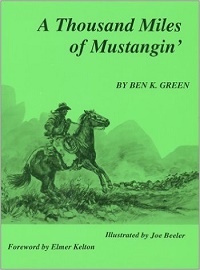
It was the "late days of the Depression," times were hard and money scarce, and Ben Green "had about used up all the hard ways to make a living a-horseback." So when he heard talk of wild mustangs free for the taking in the Big Bend country of West Texas, he saddled a road horse, put his camp on a pack horse, and headed west from Weatherford, Texas. Ben recounts his tale at an easy lope, through hot days and cold nights, with dashes of danger along the way. Eventually, he rides, ropes, trades, and talks his way through the mountains and deserts of West Texas, northwest Mexico, and Arizona, gathering horses, mules, and an assortment of characters along the way. More than a year and a thousand miles later, he will try to cut the deal that will make it all worthwhile. Displaying a wry wit, sharp opinions and a measure of luck, Ben emerges from the wild unknown a survivor. But his greatest accomplishment will be to tell A Thousand Miles of Mustangin', a range classic that rides the Western Myth well into the 20th Century.ry 12, 1074

Author: Ben K Green
Publisher: Northland Press; 1st edition hard cover
Retail: $22.95
ISBN: 978-0873580984
Copyright: January 1, 1972
Pages: 145
Books by the Author
Last Trail Drive Through Downtown Dallas, The
Publisher: Wing PublishingCopyright: August 18, 1993
Pages: 627
ISBN: 978-0517093283
Other books by the author: