Search
BlogRead the Latest News
Texas Authors Institute of History
A Unique Museum that saves history, inspires the future, depth and gives to the present..

- Details
- Written by Super User
A fascinating account of the astonishing growth of birding into a major pastime and recreational industry, as well as the author's evolution as a birder and conservationist.
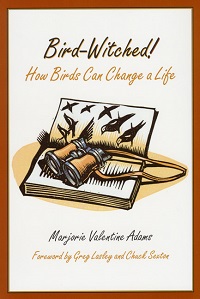 Birding can become an addiction. It starts when you hang a bird feeder in the backyard. Then you buy a bird book to identify the birds you see. Then, before you know it, you're keeping a life list and traveling the region, the country, perhaps even the world to catch glimpses of rare birds. Marjorie Adams's birding passion progressed through all these stages and continues today in her tenth decade. In this engaging and informative book, she looks back at her evolution into a full-fledged birder and the concurrent growth of the sport of birding, to which she contributed significantly as a founding member of the American Birding Association, a newspaper columnist on birding, and a teacher and producer of educational wildlife films with her husband and lifelong birding partner, "Red" Adams.
As one who was there from the beginning, Marjorie Adams is uniquely qualified to recount the astonishing rise of birding to a major pastime and recreational industry. She describes the founding of the American Birding Association and profiles its founder, James A. Tucker. She vividly recalls many of her and Red's birding adventures, from southern Canada to Mexico, as well as their encounters with a host of highly regarded birders, including Roger Tory Peterson, Pete Dunne, Victor Emanuel, Charles Hartshorne, and Roy Bedichek. She also explains how her and Red's love for birds led them to become conservation activists and how they produced an award-winning film on the endangered Golden-cheeked Warbler. Offering an important chapter in the story of birding in Texas and the United States, this book establishes Marjorie and Red Adams's rightful place among the leading Texas naturalists of recent decades.
- Details
- Written by Super User
BIRD, STEPHEN MOYLAN (1897–1919). Stephen Moylan Bird, poet, was born on October 12, 1897, in Galveston, Texas, the son of John Moylan and Alice Otis (Jones) Bird and a direct descendent of Revolutionary War general Stephen Moylan. He completed high school at the age of sixteen and wished to become a naturalist but was forced by straitened circumstances to work instead in railroading and as a clerk on the cotton exchange. In leisure moments he began to write brief lyrics, using streetcar transfers and the backs of envelopes for his manuscript paper. In the winter of 1917–18 he submitted some poems that were accepted for Contemporary Verse by the editor, Charles Wharton Stork, who described the young poet as an "American Keats" with poetic gifts that still needed to mature. Bird enlisted in 1918 as a naval recruit during World War I and was sent to the Great Lakes for training. In October 1918 he became a cadet at West Point but felt the environment to be oppressive, and on January 1, 1919, he was found dead in his room, apparently a suicide. A posthumous collection of his verses, In the Sky Garden, was published in 1922 by Yale University Press; it contained a number of imaginative lyrics on nature and one or two realistic poems.
Leonidas Warren Payne, Survey of Texas Literature (New York: Rand McNally 1928).
Citation
The following, adapted from the Chicago Manual of Style, 15th edition, is the preferred citation for this article.
William E. Bard, "ADAMS, WALTER R.," Handbook of Texas Online (http://www.tshaonline.org/handbook/online/articles/fad08), accessed March 19, 2015. Uploaded on June 9, 2010. Published by the Texas State Historical Association.
- Details
- Written by Super User
BISHOP, CURTIS KENT (1912–1967). Curtis Kent Bishop, newspaperman and author, was born in Bolivar, Tennessee, on November 10, 1912, the son of D. E. and Annie (Cornelius) Bishop. He moved to Texas as a boy, graduated from Big Spring High School in 1934, and attended the University of Texas from 1934 to 1936; at the university he was twice editor of the Ranger, the student magazine, and sports reporter for the student newspaper, the Daily Texan. He worked as a reporter for the Austin Tribune from 1939 to 1942 and the Austin American-Statesman from the time he was sixteen, a job which he later took permanently. He wrote a column, "This Day in Texas," syndicated throughout the state. During World War II Bishop was with the Foreign Broadcast Intelligence Service in Latin America and the Pacific Theater. On his return he became widely recognized for his books on sports and for his western novels, at least six of which were made into motion pictures. He wrote other books in the field of teen-age sports fiction, among them Half-Time Hero (1956) and Dribble Up (1956). In the historical field he wrote The First Texas Ranger: Jack Hays (1959) and Lots of Land (1949), the latter with James Bascom Giles. He wrote hundreds of magazine articles and was given an award by Look magazine for a television play. He wrote under several pen names. As a result of the book written with Bascom Giles, the General Land Office of Texas employed Bishop to examine its archives in order to help prepare the case for Texas in the Tidelands controversy. He worked at the Land Office for about thirteen years, between 1947 and 1967. At the time of his death he was administrative assistant in the public relations department. From 1954 to 1960 he was a member of the Texas Employment Commission. Bishop was married to Grace Eyree, and they had four children. He died of a heart attack on March 17, 1967, in Austin and was buried in Austin Memorial Park.
Vertical Files, Dolph Briscoe Center for American History, University of Texas at Austin.
Citation
The following, adapted from the Chicago Manual of Style, 15th edition, is the preferred citation for this article.
William E. Bard, "ADAMS, WALTER R.," Handbook of Texas Online (http://www.tshaonline.org/handbook/online/articles/fad08), accessed March 19, 2015. Uploaded on June 9, 2010. Published by the Texas State Historical Association.
- Details
- Written by Super User
Kelton, Elmer
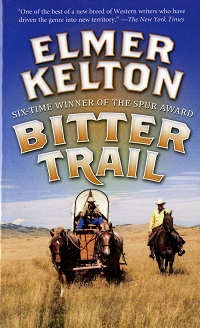 Author: Elmer Kelton
Publisher: Forge Books
Retail: Varies
ISBN: 978-0812551181
Copyright: June 15, 1997
Pages: 224
In Bitter Trail, Kelton tells the story of a tough teamster named Frio Wheeler whose wagons haul cotton from Texas to Mexico.
Sounds like a peaceable enterprise?
The problem is that the Civil War is raging throughout the South and Wheeler's cotton is to be sold for gold--gold used to buy guns and ammunition for the Confederate army.
And, added to his balky mules, the broiling heat, and killing drought of the Mexican dessert, Wheeler has even more serious matters to contend with: His wagons are attacked, his cotton bales are burned, he is captured and tortured by bandidos in league with Union sympathizers, and he is betrayed by his best friend--his former partner and brother of the woman he loves!
Editorial Reviews
 Author: Elmer Kelton
Publisher: Forge Books
Retail: Varies
ISBN: 978-0765348951
Copyright: June 3, 2008
Pages: 176
Barbed WireBitter Trail
Bowie's Mine
Day the Cowboys Quit, The
Far Canyon, The
Good Old Boys, The
Honor at Daybreak
Hot Iron
Joe Pepper
Living and Writing in West Texas
Man Who Rode Midnight, The
Many a River
Pecos Crossing
Shadow of a Star
Six Bits a Day (Hewey Calloway)
Slaughter
Time It Never Rained, The
Wolf and the Buffalo, The