Search
BlogRead the Latest News
Texas Authors Institute of History
A Unique Museum that saves history, inspires the future, depth and gives to the present..

- Details
- Written by Super User
BUREAU, ALLYRE (1810–1859). Allyre Bureau, political writer, Texas colonizer, musician, and composer, was born in Cherbourg, France, in 1810. He studied at the École Polytechnique and the Paris Conservatory, fought against the king in the July Revolution (1830), and was briefly an artillery officer. He was a Fourierist and friend of Victor P. Considérant. He wrote for Démocratie pacifique, a Fourierist publication, urged social changes in other publications, ran unsuccessfully for national office in 1848 and 1849, and spent some time in prison after the Paris riots of June 1848. He also translated English novels into French.
On September 26, 1854, in Brussels, he signed as a director the charter of the Société de Colonisation Europeo-Americaine au Texas, which founded the La Réunion colony of French and Swiss emigrants near Dallas, an experiment in the practical application of Fourier's theory. Bureau worked as part of the central agency in Paris and served on a subcommittee to initiate the society's operation. When the colony's financial problems became dire, he traveled to America with his wife, three sons, and daughter. They arrived at La Réunion on January 17, 1857. Upon the resignation of François J. Cantagrel, Bureau assumed the directorship of the colony, but, unable to reverse its deterioration, he dissolved the society on January 28, 1857. Bureau remained at the settlement, where his musical talent contributed much to the colony's reputation for good musical entertainment. He brought the first piano to Dallas and composed such songs including "Clang, Clang, Clang," and "Choose a Flower." One of his compositions appeared in a songbook used in the Dallas public schools. While beginning a trip to France with his wife and daughter for an extended visit, he contracted yellow fever and died in a sanitarium at Kellum Springs, about fifty miles north of Houston, in late 1859.
Dictionnaire de biographie française (13 vols., Paris: Letouzey et Ane, 1933–75). George H. Santerre, White Cliffs of Dallas: The Story of La Reunion (Dallas: Book Craft, 1955). Lota M. Spell,Music in Texas (Austin, 1936; rpt., New York: AMS, 1973).
Citation
The following, adapted from the Chicago Manual of Style, 15th edition, is the preferred citation for this article.
William E. Bard, "ADAMS, WALTER R.," Handbook of Texas Online (http://www.tshaonline.org/handbook/online/articles/fad08), accessed March 19, 2015. Uploaded on June 9, 2010. Published by the Texas State Historical Association.
- Details
- Written by Super User
Burnet, Texas
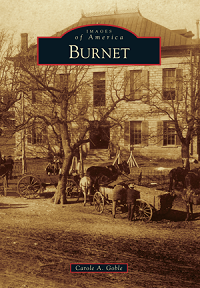 Author: Carole A Goble
Publisher: Arcadia Publishing
Retail: $21.99
ISBN: 9780738571218
Copyright: November 2009
Pages: 128
Nestled along Hamilton Creek in the hills of Central Texas, the city of Burnet began in the mid-1800s as a settlement across the creek from Fort Croghan. Initially called Hamilton, it was a travel crossroads, making it an important trade center. Logan Vandeveer built the first commercial limestone building in 1854, and Peter Kerr, a cattle merchant, later donated 100 acres of land for the county seat. The city was eventually named after David G. Burnet, the first provisional president of the Republic of Texas. Burnet is still the progressive city it has always been, building a strong infrastructure to support its growth, and yet its modern economy continues to be boosted by its past. Every week, the Hill Country Flyer steam train brings hundreds of tourists who enjoy the charming historic district and courthouse square with its shops, cafés, and friendly people.
- Details
- Written by Super User
BURNETT, THOMAS R. (1842–1916). Thomas R. Burnett, author and newspaper publisher, was probably born in Tennessee; he was taken to Fannin County, Texas, by 1850, and attended Plum Grove Academy nearby. During the Civil War he served for four years in the Confederate Army in Polignac's Brigade, Texas Cavalry. He wrote a collection of short stories and poems during the war called The Confederate Rhymes. He later gave every member of his brigade a copy of the book. After the war Burnett became a journalist and established the Bonham News and Ladonia Enterprise. He was also associated with the Denton Monitor and the Paris Press. As a master at repartee and sharp retort, he was known as a racy editor. After conversion to the Church of Christ in 1875, Burnett began the Christian Messenger in Bonham in 1876. From this date he traveled extensively in North and Central Texas in the interest of his paper, preaching, selling books, and occasionally debating. From September 1876 to September 1888 he kept a journal of numerous trips, during which he averaged three sermons a week. In 1888 he moved to Dallas and continued his paper until 1894, when it was merged with the Gospel Advocate, to which Burnett contributed a column called "Burnett's Budget" until 1898, when he began another publication in Dallas called Burnett's Budget and published until his death. Only a few issues of the Budget and the Messenger are extant. In his writings Burnett often combined controversy and good humor. Among his published works were a religious dialog and several volumes of religious poetry, including one collection titled Doctrinal Poetry. Burnett was married and had at least five children. He died on June 26, 1916, in Dallas, and was buried in Oak Cliff Cemetery.
Thomas R. Burnett Papers, Dolph Briscoe Center for American History, University of Texas at Austin. Dallas Morning News, June 27, 1916.
Citation
The following, adapted from the Chicago Manual of Style, 15th edition, is the preferred citation for this article.
William E. Bard, "ADAMS, WALTER R.," Handbook of Texas Online (http://www.tshaonline.org/handbook/online/articles/fad08), accessed March 19, 2015. Uploaded on June 9, 2010. Published by the Texas State Historical Association.
- Details
- Written by Super User
Bob Spalten is an entrepreneur who is currently in the business of oriental rug cleaning sales. He also has two air-bnb houses which are rented quite frequently. He loves reading, and had always thought about writing a book, but never did until recently. Sometime around May 2021, he woke up early one morning and started writing a book about a guy that wins fifty million. The twists and turns were not planed but evolved from writing these books. He has found writing to be one of his most enjoyable hobbies.