Search
BlogRead the Latest News
Texas Authors Institute of History
A Unique Museum that saves history, inspires the future, depth and gives to the present..

- Details
- Written by Super User
Author Michael Earney
Corpus
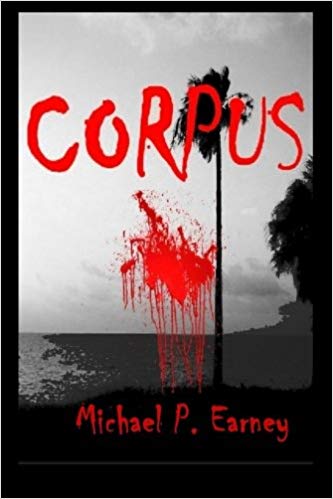
Synopsis
Corpus means there should be a body, and there is! Detective Matt Grey has to do some driving around South Texas, including Corpus Christi, Kingsville, Alice, and Port Aransas on Mustang Island, to find the connections surrounding a murder--or is it suicide? Malfeasance and family feuding will keep you page-turning.
- Details
- Written by Super User

Author: Tommy Stringer
Publisher: Arcadia Publishing
Retail: $21.99
ISBN: 978-0738578781
Copyright: December 2009
Pages: 128
The first Texas legislature created Navarro County in 1846 and named it in honor of Texas patriot Jose Antonio Navarro. When asked to name the new seat of government, Navarro replied, "Call it Corsicana for the island of Corsica, the birthplace of my father." From its beginnings in 1848, Corsicana's history has been marked by Texas icons such as cotton, cattle, and chili. The town's history took a dramatic turn when drillers looking for water struck oil instead in 1894. By the end of the decade, more than 500 wells dotted the landscape, marking the first commercial oil field in Texas and launching the industry that has become synonymous with the Lone Star State. Oil, business enterprises, and politics are important parts of Corsicana's legacy, but much of its history is found in the everyday events that make up the fabric of a community. Local history is filled with stories of people who overcame obstacles to fulfill the American Dream.
- Details
- Written by Super User
COUSINS, WALTER HENRY (1878–1942). Walter Henry Cousins, pharmacist, poet, and historian, the son of Henry Clay and Frances Cousins, was born on August 18, 1878, near Whitson, Texas. He attended Whitson, Walker, and Haunted Hill schools. In 1898 his family moved west to Haskell County, where Walter worked as a bronco buster on the MN Ranch in Haskell, Throckmorton, and Knox counties. He was also camp cook for trail drives across Oklahoma during this period. In 1902, after an apprenticeship, he became a licensed druggist. That year he also married Sue Reeves McClendon. They eventually had two children. Cousins was appointed a member of the State Board of Pharmacy in 1913 and became secretary in 1920. He held this office until December 1, 1941, when ill health forced him to retire. He bought and became editor of the Southern Pharmaceutical Journal in Dallas in 1915. That year he was elected secretary-treasurer of the Texas Pharmaceutical Association, and in 1918 he became president of the National Association of Retail Druggists. He owned drugstores in Munday and Wichita Falls.
He helped to establish the Texas Cowboy Reunion at Stamford in 1930 and served as historian, vice president, and president of the Reunion Association. He was author of Cuz (1922) and "Range Poems" in Lona Shawver's Chuck Wagon Windies (1934). He also wrote numerous poems, ballads, and articles that appeared in pharmaceutical journals and Texas Cowboy Reunion publications. He died in Dallas on February 6, 1942.
BIBLIOGRAPHY:
Cattleman, March 1942. Vertical Files, Dolph Briscoe Center for American History, University of Texas at Austin.
Laura Simmons
Citation
The following, adapted from the Chicago Manual of Style, 15th edition, is the preferred citation for this article.
William E. Bard, "ADAMS, WALTER R.," Handbook of Texas Online (http://www.tshaonline.org/handbook/online/articles/fad08), accessed March 19, 2015. Uploaded on June 9, 2010. Published by the Texas State Historical Association.
- Details
- Written by Super User
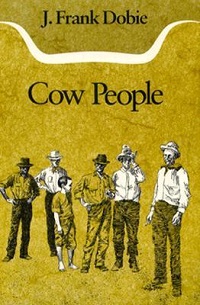
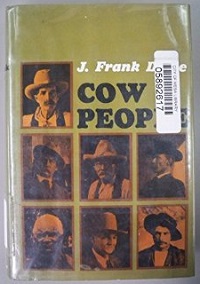
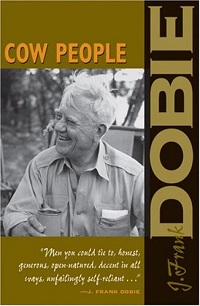 Cow People records the fading memories of a bygone Texas, the reminiscences of the cow people themselves. These are the Texans of the don't-fence-me-in era, their faces pinched by years of squinting into the desert glare, tanned by the sun and coarsened by the dust of the Chisholm Trail. Their stories are often raucous but just as often quiet as hot plains under a pale Texan sky.
A native Texan, J. Frank Dobie had an inborn knowledge of the men and customs of the trail camps. Cattlemen were as various as the country was big. Ab Blocker was a tall, quiet man who belonged totally to the cattle and the silent plains. But big men often had big lungs. "Shanghai Pierce was the loudest man in the country. He would sit at one end of a day coach and in normal voice hold conversation with some man at the other end of the coach, who of course had to yell, while the train was clanking along. He knew everybody, yelled at everybody he saw."
Texas bred tall men and taller stories. There was Findlay Simpson, who played havoc with fact but whiled away the drivers' long, lonely evenings with his tales. Old Findlay told of a country so wet that it bogged down the shadow of a buzzard, and of cattle that went into hibernation during rugged winters; he once spun yarns for three days straight, outlasting his listeners in a marathon of endurance.
All real cow people—from the cattle drivers to the cattle owners—lived by a simple code based on the individual's integrity. Bothering anyone else's poke or business uninvited was strictly forbidden, and enforcement of this unwritten law was as easy as pulling a trigger. Honesty was taken for granted, and a cowman's name on a check made it negotiable currency.
Yet Texas had its "bad guys"—the crooks, the thieves, even the tightwads. "A world big enough to hold a rattlesnake and a purty woman is big enough for all kinds of people," wrote Dobie. This is the world whose vast and various population the reader will find in Cow People.
We have not been able to confirm that image 1 is from the original print, nor what reprint year image two is from. We do know that the University of Texas Press reprint of 1981 is image three.
Other books by the author:
Apache Gold and Yaqui Silver
Cow People
Coronado's Children
Ben Lilly Legend, The
Bob More: Man and Bird Man
I'll Tell You a Tale
Flavor of Texas, The
Legends of Texas Vol 1
Legends of Texas Vol 2
Longhorns, The
Mustangs, The
Mustangs and Cow Horses
Tales of Old Time Texas
Vaquero of the Brush Country, A