Search
BlogRead the Latest News
Texas Authors Institute of History
A Unique Museum that saves history, inspires the future, depth and gives to the present..

- Details
- Written by Super User

Dixie is a recent widow, mother of three, and grandmother. She wrote a humor column for 25 years for several local Houston area newspapers. She lives near Houston, Texas where she creates and teaches art quilting.
Her book cover is one of her art quilts. Her author website is www.dixiefrantz.com

- Details
- Written by Super User
DIXON, SAMUEL HOUSTON (1855–1941). Samuel Houston Dixon, editor, author, and fruit grower, son of Shadrach and Judith (Covington) Dixon, was born on a farm in Hays County, Texas, on August 4, 1855. He attended Coronal Institute in San Marcos and received his baccalaureate degree from Baylor University in 1878. He taught school for four years before joining the staff of the Galveston News. In 1880 he married Baylor classmate Jennie Alice Wagner of Robertson County. They had five children. Between 1885 and 1888 Dixon served in a series of state appointments that included committee clerk for the state legislature from 1889 to 1891, journal clerk for the Twentieth Legislature, and chief clerk of the Department of Agriculture.
In 1889 he became the editor of the Southern Mercury, the official paper of the Farmers' Alliance, published in Dallas. During this period Jennie Dixon served as the secretary of the state Woman's Christian Temperance Union and edited the Texas state temperance journal, the White Ribbon. Mrs. Dixon also managed the women's department of the Southern Mercury. The Farmers' Alliance ousted the Dixons from the Mercury when Sam supported Gov. James S. Hogg's opposition to the subtreasury and an elected Railroad Commission. In 1891 the state House of Representatives elected Dixon chief clerk. After the legislative session he served as inspector of state penitentiaries and edited Farmer's World, an anti-subtreasury newspaper organized by the pro-Hogg faction of the Farmers' Alliance to oppose the alliance's drift toward the People's party.
In 1895 Dixon moved to a farm in Montgomery County. After four years he became an immigration agent for the Houston, East and West Texas Railway. Between 1903 and 1913 he held a series of state agricultural offices including horticultural representative to the St. Louis World's Fair, chief of the orchard and nursery inspection division, chief clerk of the agricultural department, and collaborator for the United States Department of Agriculture. In 1915 Dixon served in the state House of Representatives.
In 1906 he moved to Houston to edit Texas Farm and Fireside. In his career as an agricultural journalist he contributed to the development of the peach and citrus industry in Texas. His agricultural publications include Money Crops (1901), Texas Fruits at the World's Fair, 1904 (1905), A.B.C. of Truck Growing (1909), and A.B.C. of Fruit Growing (1914). He was a prolific writer in other fields. In 1876 he published Ten Nights with Big Foot Wallace, which was followed by Robert Warren, the Texas Refugee (1879) and Agnes Dale (1882). In 1885 he produced an anthology of Texas verse, Poets and Poetry of Texas. In 1924 he published two historical works, The Men Who Made Texas Free and Romance and Tragedy of Texas History. In 1932 he and Louis Wiltz Kemp coauthored The Heroes of San Jacinto.
Besides agricultural associations, Dixon belonged to the Houston Press Club, the Southern Benevolent Association, the Texas Progressive Club, the Knights of Pythias, the Loyal Order of Moose, and the Knights and Ladies of Honor. He died on October 23, 1941, and was buried in Houston. He was survived by two daughters and three sons.
BIBLIOGRAPHY:
- W. Geiser,Horticulture and Horticulturists in Early Texas(Dallas: University Press, 1945). Houston Post, October 24, 1941. Frank W. Johnson, A History of Texas and Texans (5 vols., ed. E. C. Barker and E. W. Winkler [Chicago and New York: American Historical Society, 1914; rpt. 1916]). Memorial and Biographical History of Dallas County (Chicago: Lewis, 1892; rpt., Dallas: Walsworth, 1976).
Keith L. King
Citation
The following, adapted from the Chicago Manual of Style, 15th edition, is the preferred citation for this article.
William E. Bard, "ADAMS, WALTER R.," Handbook of Texas Online (http://www.tshaonline.org/handbook/online/articles/fad08), accessed March 19, 2015. Uploaded on June 9, 2010. Published by the Texas State Historical Association.
- Details
- Written by Super User
DOBIE, BERTHA MCKEE (1890–1974). Bertha McKee Dobie, writer, daughter of Richard Alexander and Ray (Park) McKee, was born on July 8, 1890, on a farm in Susquehanna County (near Nicholson), Pennsylvania; at that time her parents had already established residence in Texas, but her mother had returned to Pennsylvania to have her first child. The family lived for short periods in the small Texas towns of Italy, Forreston, Coldspring, Waelder, and Aransas Pass before settling in Velasco when Bertha was seven years old. After graduation from high school she received a B.A. degree from Southwestern University in Georgetown (where she met her future husband) in 1910; she took a master's degree in English from the University of Texas in 1918. She taught English and mathematics in Dalhart, Galveston, and Alexander Collegiate Institute (now Lon Morris College) in Jacksonville.
Bertha McKee was married to J. Frank Dobie on September 20, 1916, and in later years she was credited by her husband as being his best literary critic and editor. She became a writer and contributed a series of articles on gardening to Texas newspapers; she also wrote for numerous periodicals, including Nature Magazine, New York Herald Tribune Magazine, Garden Digest, Holland's Magazine, Publications of the Texas Folklore Society, and Southwest Review. She was assistant editor of the Texas Folklore Society Publications from 1923 to 1935. Occasionally she conducted classes at the University of Texas for her husband while he was away collecting materials for his books. She was well known for the flower garden at her home in Austin and was a guest lecturer on gardening at meetings throughout the state. Bertha Dobie was a member of the Audubon Society and helped formulate plans for Paisano Ranch, a Hill Country retreat for Texas writers and artists. Upon the death of her husband, she edited his posthumous publications. She was named a distinguished alumna of Southwestern University on January 26, 1973. She died on December 18, 1974, and was buried alongside her husband in the State Cemetery in Austin.
BIBLIOGRAPHY:
Austin American-Statesman, May 3, 1987. Vertical Files, Dolph Briscoe Center for American History, University of Texas at Austin.
Eldon S. Branda
Citation
The following, adapted from the Chicago Manual of Style, 15th edition, is the preferred citation for this article.
William E. Bard, "ADAMS, WALTER R.," Handbook of Texas Online (http://www.tshaonline.org/handbook/online/articles/fad08), accessed March 19, 2015. Uploaded on June 9, 2010. Published by the Texas State Historical Association.
- Details
- Written by Super User
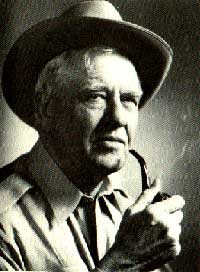
DOBIE, JAMES FRANK (1888–1964). J. Frank Dobie, folklorist, was born on a ranch in Live Oak County, Texas, on September 26, 1888, the eldest of six children of Richard J. and Ella (Byler) Dobie. His ranching heritage became an early influence on his character and personality. His fundamentalist father read the Bible to Frank and the other five children, and his mother read them Ivanhoe and introduced them to The Scottish Chiefs, Pilgrim's Progress, andSwiss Family Robinson. He left the ranch when he was sixteen and moved to Alice, where he lived with his Dubose grandparents and finished high school. In 1906 he enrolled in Southwestern University in Georgetown, where he met Bertha McKee, whom he married in 1916, and Professor Albert Shipp Pegues, his English teacher, who introduced him to English poetry, particularly the Romantics, and encouraged him as a writer. Dobie's education as a teacher and writer continued after graduation in 1910. He worked two summers as a reporter, first for the San Antonio Express and then the Galveston Tribune. He got his first teaching job in 1910 in Alpine, where he was also the principal, play director, and editor of the school paper. He returned to Georgetown in 1911 and taught in the Southwestern University preparatory school until 1913, when he went to Columbia to work on his master's degree. With his new M.A. he joined the University of Texas faculty in 1914. At this time he also joined the Texas Folklore Society. Dobie left the university in 1917 and served for two years in the field artillery in World War I. His outfit was sent overseas right at the war's end, and he returned to be discharged in 1919. In 1919 he published his first articles. He resigned his position at the university in 1920 to manage his uncle Jim Dobie's ranch. During this year on the Rancho de Los Olmos with the vaqueros and the stock and the land that had been part of his formation, Dobie discovered his calling-to transmute all the richness of this life and land and culture into literature. The Texas Folklore Society was the main avenue for his new mission, and the University of Texas library with all its Texas resources was his vehicle.
Dobie returned to Austin and the university in 1921. The Texas Folklore Society had been formed in 1909 by Leonidas W. Payne and others, but had recessed during the war years. On April 1, 1922, Dobie became secretary of the society. He immediately began a publication program. Legends of Texas (1924) carried the seeds of many of his later publications. Dobie served as the society's secretary-editor for twenty-one years and built the society into a permanent professional organization. When the university would not promote him without a Ph.D., Dobie accepted the chairmanship of the English department at Oklahoma A&M, where he stayed from 1923 to 1925. During these two years he began writing for the Country Gentleman. With considerable help from his friends on the UT campus, he was able to return in 1925 with a token promotion. He began writing articles on Texas history, culture, and folklore for magazines and periodicals and soon started to work on his first book, A Vaquero of the Brush Country. Dobie's purpose in life from the time of his return to the university in 1921 was to show the people of Texas and the Southwest the richness of their culture and their traditions, particularly in their legends. John A. Lomax, another founder of the Texas Folklore Society, had done this with his collecting and publishing cowboy songs; Dobie intended to do this with the tales of old-time Texas and through the publications of the society and his own writing.
His Vaquero of the Brush Country, published in 1929, established him as a spokesman of Texas and southwestern culture. It was based on John Young the Vaquero's autobiographical notes and articulated the struggle of the individual against social forces, in this case the battle of the open-range vaquero against barbed wire. Two years later Dobie published Coronado's Children (1931), the tales of those free spirits who abandoned society in the search for gold, lost mines, and various other grails. It won the Literary Guild Award for 1931 and, combined with his continuing success as a popular writer in Country Gentleman, made Dobie a nationally known literary figure. He was also promoted in 1933 to the rank of full professor, the first Texan non-Ph.D. to be so honored at the university. In 1942 he published the Guide to Life and Literature of the Southwest, an annotated reading list. It was published again in 1952. As head of the Texas Folklore Society and author of On the Open Range (1931), Tales of the Mustang (1936), The Flavor of Texas (1936), Apache Gold and Yaqui Silver (1939), and Tongues of the Monte (1947), Dobie was the state's leading spokesman and literary and cultural figure during the Texas Centennial decade, the 1930s. His first period of writing ended with the publication of The Longhorns in 1941.
He spent World War II teaching American literature in Cambridge. After the war he returned to Europe to teach in England, Germany, and Austria. He said of his Cambridge experience in A Texan in England that it gave him a broader perspective, that it was his beginning of his acceptance of civilization, an enlightened civilization free of social and political rigidities and with full respect for individuality. In Texas the University of Texas regents, critical of the university's liberal professors, had fired President Homer P. Rainey in November 1944. Dobie, a liberal Democrat, was outraged and vociferous, and Governor Coke Stevenson said that he was a troublemaker and should be summarily dismissed. Dobie's request for a continuation of his leave of absence after his European tour in 1947 was denied by the regents, and he was dismissed from the UT faculty under what became known as the "Dobie rule," which restricted faculty leaves of absence to two years except in emergencies.
After this separation Dobie devoted all of his time to writing and anthologizing. The next decade saw the publication of The Voice of the Coyote (1949), The Ben Lilly Legend (1950), The Mustangs (1952), Tales of Old Time Texas (1955), Up the Trail From Texas (1955), and I'll Tell You a Tale (1960). Before he died he published Cow People (1964) and almost finished the manuscript for Rattlesnakes, which Bertha McKee Dobie later edited and published in 1965. Dobie began writing for the Southwest Review in 1919, when it was the Texas Review, and continued the association throughout his life. The Southwest Review published his John C. Duval: First Texas Man of Letters in 1939. Dobie wrote a Sunday newspaper column from 1939 until his death, and as an outspoken critic of the Texas scene he was a popular subject of newspaper stories. His most celebrated targets were professional educationists ("unctuous elaborators of the obvious"); state politicians ("When I get ready to explain homemade fascism in America, I can take my example from the state capitol of Texas"); Pompeo Coppini's Alamo cenotaph ("From a distance it looks like a grain elevator or one of those swimming pool slides"); and inappropriate architecture (a friend reports his saying that the University Tower, into which he refused to move, "looked like a toothpick in a pie, ought to be laid on its side and have galleries put around it"). His war against bragging Texans, political, social, and religious restraints on individual liberty, and the mechanized world's erosion of the human spirit was continual.
Dobie died on September 18, 1964. He had been feted by the Southwestern Writers and the Texas Folklore Society. Special editions of the Texas Observer and the Austin American-Statesmanqqv had been devoted to his praise by his many admirers, and President Lyndon B. Johnson awarded him the nation's highest civil award, the Medal of Freedom, on September 14, 1964. His funeral was held in Hogg Auditorium on the UT campus, and he was buried in the State Cemetery. See also PAISANO RANCH.
BIBLIOGRAPHY:
Francis Edward Abernethy, J. Frank Dobie (Austin: Steck-Vaughn, 1967). Winston Bode, A Portrait of Pancho: The Life of a Great Texan, J. Frank Dobie (Austin: Pemberton Press, 1965). Texas Observer, Special Issue, July 24, 1964. Lon Tinkle, An American Original: The Life of J. Frank Dobie (Boston: Little, Brown, 1978).
Francis E. Abernethy
Photo Credit 1: Billy Hathom - "I took photo of J. Frank Dobie at National Portrait Gallery in Washington, D.C., with Canon camera." U.S. government photo. Public domain
Photo Credit 2: Unknown
Citation
The following, adapted from the Chicago Manual of Style, 15th edition, is the preferred citation for this article.
William E. Bard, "ADAMS, WALTER R.," Handbook of Texas Online (http://www.tshaonline.org/handbook/online/articles/fad08), accessed March 19, 2015. Uploaded on June 9, 2010. Published by the Texas State Historical Association.
Books by the Author
Apache Gold and Yaqui Silver
Cow People
Coronado's Children
Ben Lilly Legend, The
Bob More: Man and Bird Man
I'll Tell You a Tale
Flavor of Texas, The
Legends of Texas Vol 1
Legends of Texas Vol 2
Longhorns, The
Mustangs, The
Mustangs and Cow Horses
Tales of Old Time Texas
Vaquero of the Brush Country, A