Search
BlogRead the Latest News
Texas Authors Institute of History
A Unique Museum that saves history, inspires the future, depth and gives to the present..

- Details
- Written by Super User
Knapik, Jane
 Author: Jane Knapik
Publisher: Eakin Pr; 1st edition
Retail: Not Available
ISBN: 978-1571681072
Copyright: June 1996
Pages: 84
Presents short biographies of ten noted Texas ranchers, including Charles Schreiner, Watt Matthews, and Mary Nan West.
Other Books by the Author:
Would You Like to Ride With...:
- Details
- Written by Super User
Kelton, Elmer
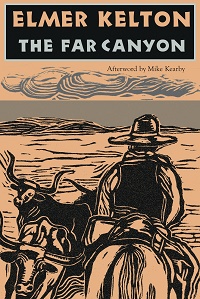 Author: Elmer Kelton
Publisher: Texas Christian University Press
Retail: Varies
ISBN: 978-0875654126
Copyright: April 22, 2010
Pages: 336
In The Far Canyon, Kelton masterfully unveils for his reader the finality of the buffalo’s demise, the beginning of a time when cattle would replace the American bison on the southern plains and ultimately end the Plains Indian culture. The novel reveals the history of the period, not in a general grand swoop of the pen, but rather, up close and personal, so his readership can judge the impact of the period upon his characters.
The novel’s first chapter introduces Comanche warrior Crow Feather, whose situation is emblematic of a common recurring theme in all of Kelton’s works . . . change. Protagonist Jeff Layne is faced with the very same dramatic problem, the devastating threat to one’s self-concept inherent in change. Layne, the hide hunter from Slaughter is weary of killing and death. He decides to return to South Texas, determined to earn his living with the newest resource on the plains, cattle. And the cultures collide.
Kelton eloquently reveals the impact of hide hunters on Plains Indian culture. Crow Feather realizes that no matter how many whites the Comanche kill, there will always be more “coming back.” Crow Feather also understands that his life and the lives of his wives and children will never be easy again. Are Layne and Crow Feather of a character that will allow them to escape a predetermined fate by reaching that far canyon, or will they simply perish under the cultural dictate of their historical time?
The question is a thematic dilemma that Kelton excels at and it is what transforms his writing into serious literature.
Editorial Reviews
From Publishers Weekly
Veteran western writer Kelton begins this sequel to Slaughter exactly where that Golden Spur-winning yarn ended, in Texas, 1874. After the Battle of Adobe Walls, the Commanche warrior Crow Feather lies bleeding but alive. Jeff Layne, too, has survived--just as he survived both a Union slug during the Civil War and his days as a buffalo hunter during the great bison slaughters. Now Layne, tired of death and killing, is headed back to south Texas to resume ranching. But when he and his wayward band (including old friend and camp cook Cap Doolittle, and Englishman Nigel Smithwick and his untutored American bride, Arletta) reach their destination, Layne discovers that a ruthless Yankee reconstruction government has wreaked havoc and that his ranch is now owned by his old enemy, Vesper Freed. But Texas is a big place, and, rather than fight for his land, Layne decides to move north and start again. Still, he can't avoid the inevitable tangle with Freed. Layne and his companions' story is interlaced with that of Crow Feather, whose hope of living a peaceful, isolated existence with his people seems to have been dashed when he's confined to a degrading and violent reservation. Despite being longer than the average western, this well-plotted novel holds interest and will prove especially rewarding for those already caught up in the adventures of Crow Feather, Layne and company.
Copyright 1994 Reed Business Information, Inc. --This text refers to an out of print or unavailable edition of this title.
From Library Journal
Kelton, a prolific and award-winning author of Westerns, has produced another solid success in this sequel to Slaughter (Doubleday, 1992). Ten years after the Civil War, Jeff Layne, a Confederate veteran weary of killing both men and buffalo, wends his way along dusty cattle trails toward his family ranch in Texas. When he gets to his hometown, however, he finds that the property has been stolen by the dastardly Vesper Freed, who also stole Jeff's girl, Eva, some years ago. Jeff decides to gather up some cattle and a party of companions and head to a remote canyon in north Texas to start up a new ranch. Along the way, the party encounters Crow Feather and his Comanche family, who are trying to escape from the newly formed reservation. Written with obvious knowledge of the American frontier and Native American culture, this grand saga will appeal to fans of Larry McMurtry. Highly recommended.
Rebecca House Stankowski, Purdue Univ. Calumet Lib., Hammond, Ind.
Copyright 1994 Reed Business Information, Inc. --This text refers to an out of print or unavailable edition of this title.
 Author: Elmer Kelton
Publisher: Forge Books; First Edition/First Printing edition
Retail: Varies
ISBN: 978-0765348944
Copyright: April 7, 2007
Pages: 224
Barbed WireBitter Trail
Bowie's Mine
Day the Cowboys Quit, The
Far Canyon, The
Good Old Boys, The
Honor at Daybreak
Hot Iron
Joe Pepper
Living and Writing in West Texas
Man Who Rode Midnight, The
Many a River
Pecos Crossing
Shadow of a Star
Six Bits a Day (Hewey Calloway)
Slaughter
Time It Never Rained, The
Wolf and the Buffalo, The
- Details
- Written by Super User
FARMER, JAMES LEONARD, SR. (1886–1961). James Leonard Farmer, Sr., believed to be the first black man in Texas to have a Ph.D., was born on June 12, 1886, in Kingstree, South Carolina, the son of Carolina and Lorena (Wilson) Farmer. His parents were former slaves. He attended grade school in Pearson, Georgia, and then studied at Cookman Institute in Daytona Beach, Florida, before going to Boston University, where he received B.A. and S.T.B. degrees. He received the Ph.D from Boston University in 1918. He also studied at Harvard in 1916–17 and received an honorary doctorate in 1929 from Gammon Theological Seminary, Atlanta, Georgia.
Farmer was a deacon in the Methodist Episcopal Church in 1917 and after college served as pastor of black churches in Texarkana and Galveston. He taught philosophy and religion and also served in administrative capacities at Wiley College in Marshall, Texas (1919–20, 1933–38); Rust College, Holly Springs, Mississippi (1920–25); Samuel Huston (now Huston-Tillotson) College, Austin, Texas (1925–30, 1946–56); Gammon Theological Seminary (1930–33); and Howard University, Washington, D.C. (1938–46). From 1932 to 1956 he was also dean of Gulfside Summer School of Ministerial Training in Mississippi. He was versed in Greek, Hebrew, Aramaic, Latin, French, and German; he was a poet and the author of two books, The Coming of Peace and the Prince of Peace (1943) and John and Jesus in Their Day and Ours (1956). He wrote biblical criticism, articles for secular magazines, and Sunday school lessons for the Southwestern Christian Advocate (see UNITED METHODIST REPORTER) and contributed several sermons to a book, Pulpit Eloquence(1939).
Farmer married Pearl Marion Houston on September 2, 1917. They had three children. One, James Leonard Farmer, Jr., became a civil rights leader and founder of the Congress of Racial Equality. Farmer was a Mason, a Republican, and a member of Omega Psi Phi. He died in Washington, D.C., on May 14, 1961. In 1997 a Texas state historical marker was dedicated on the campus of Wiley College in Marshall, Texas.
BIBLIOGRAPHY:
National Cyclopaedia of American Biography, Vol. 48. James Farmer, Lay Bare the Heart: An Autobiography of the Civil Rights Movement (New York: Arbor House, 1985).
Gail K. Beil
Citation
The following, adapted from the Chicago Manual of Style, 15th edition, is the preferred citation for this article.
William E. Bard, "ADAMS, WALTER R.," Handbook of Texas Online (http://www.tshaonline.org/handbook/online/articles/fad08), accessed March 19, 2015. Uploaded on June 9, 2010. Published by the Texas State Historical Association.
- Details
- Written by Super User
FAULK, JOHN HENRY (1913–1990). John Henry Faulk, humorist and author, fourth of five children of Henry and Martha (Miner) Faulk, was born in Austin, Texas, on August 21, 1913. His parents were staunch yet freethinking Methodists who taught him to detest racism. He entered the University of Texas in 1932. Under the guidance of J. Frank Dobie, Walter P. Webb, and Roy Bedichek,qqv he developed his considerable abilities as a collector of folklore. For his master's degree thesis, Faulk recorded and analyzed ten African-American sermons from churches along the Brazos River. His research convinced him that members of minorities, particularly African Americans, faced grave limitations of their civil rights. Between 1940 and 1942, Faulk taught an English I course at the University, using mimicry and storytelling to illustrate the best and worst of Texas societal customs. Often made to feel inferior at faculty gatherings, Faulk increasingly told unbelievable tales and bawdy jokes. His ability both to parody and to praise human behavior led to his entertainment and literary career. Early in World War II the army refused to admit him because of a bad eye. In 1942 he joined the United States Merchant Marine for a year of trans-Atlantic duty, followed by a year with the Red Cross in Cairo, Egypt. By 1944 relaxed standards allowed the army to admit him for limited duty as a medic; he served the rest of the war at Camp Swift, Texas.
Radio provided Faulk the audience he, as a storyteller, craved. Through his friend Alan Lomax, who worked at the CBS network in New York, Faulk became acquainted with industry officials. During Christmas 1945, Lomax hosted a series of parties to showcase Faulk's yarn-spinning abilities. When discharged from the army in April 1946, CBS gave Faulk his own weekly radio program, entitled "Johnny's Front Porch"; it lasted a year. Faulk began a new program on suburban station WOV in 1947 and the next year moved to another New Jersey station, WPAT, where he established himself as a raconteur while hosting "Hi-Neighbor," "Keep 'em Smiling," and "North New Jersey Datebook." WCBS Radio debuted the "John Henry Faulk Show" on December 17, 1951. The program, which featured music, political humor, and listener participation, ran for six years.
Faulk's radio career ended in 1957, a victim of the Cold War and the blacklisting of the 1950s. Inspired by Wisconsin Senator Joseph McCarthy, AWARE, Incorporated, a New York-based, for-profit, corporation, offered "clearance" services to major media advertisers and radio and television networks. For a fee, AWARE would investigate the backgrounds of entertainers for signs of Communist sympathy or affiliation. In 1955 Faulk earned the enmity of the blacklist organization when he and other members wrested control of their union, the American Federation of Television and Radio Artists from officers under the aegis of AWARE. In retaliation, AWARE branded Faulk a Communist. When he discovered that the AWARE bulletin prevented a radio station from making him an employment offer, Faulk sought redress. Several prominent radio personalities and CBS News vice president Edward R. Murrow supported Faulk's effort to end blacklisting. With financial backing from Murrow, Faulk engaged New York attorney Louis Nizer. Attorneys for AWARE, including McCarthy-committee counsel Roy Cohn, managed to stall the suit, which was originally filed in 1957, for five years. When the trial finally concluded in a New York courtroom, the jury had determined that Faulk should receive more compensation than he sought in his original petition. On June 28, 1962, the jury awarded him the largest libel judgment in history to that date—$3.5 million. An appeals court subsequently reduced the amount to $500,000. Legal fees and accumulated debts erased the balance of the award.
Despite his vindication, CBS did not rehire Faulk—indeed, years passed before he worked again as a media entertainer. He returned to Austin in 1968. From 1975 to 1980 he appeared as a homespun character on the television program "Hee-Haw." During the 1980s he wrote and produced two one-man plays. In both Deep in the Heart (1986) and Pear Orchard, Texas, he portrayed characters imbued with the best of human instincts and the worst of cultural prejudices. The year 1974 proved pivotal for Faulk. CBS Television broadcast its movie version of Fear on Trial, Faulk's 1963 book that described his battle against AWARE. Also in 1974, Faulk read the dossier that the FBI had maintained on his activities since the 1940s. Disillusioned and desirous of a return to the country, Faulk moved to Madisonville, Texas. He returned to Austin in 1981. In 1983 he campaigned for the congressional seat abdicated by Democrat-turned-Republican Phil Gramm. Although he lost the three-way race, the humorist had spoken his mind. During the 1980s he traveled the nation urging university students to be ever vigilant of their constitutional rights and to take advantage of the freedoms guaranteed by the First Amendment. The Center for American History at the University of Texas at Austin sponsors the John Henry Faulk Conference on the First Amendment.
In 1940 Faulk wed one of his students at the University of Texas, Hally Wood. They had a daughter. After he and Hally were divorced, Faulk married Lynne Smith, whom he met at a New York City rally for presidential candidate Henry Wallace in the spring of 1948. Born of their marriage were two daughters and a son. After his divorce from Lynne, Faulk married Elizabeth Peake in 1965: they had a son. Faulk died in Austin of cancer on April 9, 1990. The city of Austin named the downtown branch of the public library in his honor.
BIBLIOGRAPHY:
Austin American-Statesman, April 10, 1990. Michael C. Burton, John Henry Faulk: The Making of a Liberated Mind (Austin: Eakin Press, 1993). John Henry Faulk Papers, Dolph Briscoe Center for American History, University of Texas at Austin. Andie Tucher, ed., Bill Moyers, A World of Ideas II: Public Opinions from Private Citizens (New York: Doubleday, 1990). Vertical Files, Dolph Briscoe Center for American History, University of Texas at Austin.
Page S. Foshee
Citation
The following, adapted from the Chicago Manual of Style, 15th edition, is the preferred citation for this article.
William E. Bard, "ADAMS, WALTER R.," Handbook of Texas Online (http://www.tshaonline.org/handbook/online/articles/fad08), accessed March 19, 2015. Uploaded on June 9, 2010. Published by the Texas State Historical Association.