Search
BlogRead the Latest News
Texas Authors Institute of History
A Unique Museum that saves history, inspires the future, depth and gives to the present..

- Details
- Written by Super User
Houston, Texas (Postcards)
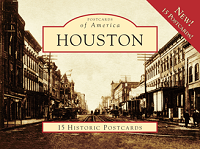 Author: Daniel E. Monsanto
Publisher: Arcadia Publishing
Retail: $7.99
ISBN: 978-0738571720
Copyright: October 2009
Pages: 128
Along the banks of Buffalo Bayou, Houston was founded by John and Augustus Allen on August 30, 1836. The city was named after Gen. Sam Houston, a prominent military hero of the Texas Revolution. After the Civil War ended, Houston flourished as agricultural, industrial, and commercial interests generated economic growth. In 1901, the discovery of oil at nearby Spindletop ushered in a new era, fueled by the addition of an inland port when the Houston Ship Channel was dredged in 1914. During the latter half of the 20th century, energy, space exploration, and the medical sciences placed this city on the world stage. Big dreams, big discoveries, hard work, and a little luck made Houston the thriving city it is today.
- Details
- Written by Super User
Howdy and thank you for your interest in being added to the museum. Each Texas Author receives a basic FREE membership to the museum. This includes your author bio, author pic and a link to your Amazon Author Page or your Amazon book page. To receive this, simply email your information to us at TexasAuthors@outlooklcom
Once we receive the information, we will create your page and send you a link to verify the information is correct.
You will also be added to our newsletter program to keep you up to date on programs, events and valuable tools to help you market your book.
We do encourage you to join as a paid member to the museum to receive even more benefits in marketing your books, discounts, and much more. Click here to select the level of membership you would like to enjoy.
Thank you again for being a Texas Author.
- Details
- Written by Super User
HOWARD, ROBERT ERVIN (1906–1936). Robert E. Howard, writer, the only child of Dr. Isaac Mordecai and Hester Jane (Ervin) Howard, was born on January 22, 1906, in Peaster, Texas, and educated in Central Texas schools, including the school at Cross Plains, where he lived most of his life. For one year, at the age of twelve, he lived in New Orleans, Louisiana, while his father did additional medical study. Because Cross Plains did not offer the final year of high school he and his mother lived in a boarding house in Brownwood while he completed his senior year. After graduating from Brownwood High School in 1923 Howard returned to Cross Plains and worked at a variety of odd jobs. In 1925 he returned to Brownwood to obtain a business certificate from Howard Payne College. He received the one-year certificate in 1927 but never used it. During his year at Howard Payne he wrote stories for the school newspaper and for the Daniel Baker College newspaper and sold his first story to Weird Tales, a popular pulp magazine. Encouraged by his entry into the pulp market and by his friend Tevis Clyde Smith, who printed Howard's earliest "published" works on a small portable press, Howard resolved to support himself by writing and went on to author all sorts of formula fiction including fight stories, ghost stories, historical adventures, and heroic fantasies. In Cross Plains Howard's neighbors complained that his typewriter kept them awake at night while he churned out stories for a penny a word. He reportedly earned $500 in one month during the Great Depression, when the local bank president earned less than a third that amount. Howard bought a new Chevrolet for cash in 1935, supposedly the only person in Cross Plains who could afford to do so.
Despite his success he was an unhappy young man with few friends. Apparently he and his mother had a neurotic dependence on each other. When his mother slipped into a coma on June 11, 1936, and the nurse told Howard that she would never regain consciousness, he went out to his car and committed suicide by shooting himself through the head. His mother died a few hours later. Although none of Howard's works was published in book form during his lifetime, novels serialized in pulp magazines, in addition to collections of short stories and poetry, have since been published as books. His most influential achievement, however, lies in his characters. Among the most famous were Solomon Kane, a somber English Puritan who fought all manner of ghosts and vampires in Elizabethan England and Africa, Bran Mak Morn, a savage Pict who battled the iron legions of Rome as well as supernatural menaces, and King Kull, a warrior of fabled Atlantis. Conan the Barbarian was Howard's most popular character; he appeared in some eighteen adventure stories. Describing his protagonists, Howard said: "They're simpler. You get them in a jam, and no one expects you to rack your brains inventing clever ways for them to extricate themselves. They are too stupid to do anything but cut, shoot, or slug themselves into the clear." Decades later, Howard's works, and pastiches based on his works and characters, sold more copies than the works of any other fantasy writer except J. R. R. Tolkien. Conan lived on in a monthly comic book and in movies, and studies of Howard's life and work appeared with increasing frequency.
Abilene Reporter-News, November 16, 1976. John Bloom, "The Last Barbarian," Texas Monthly, May 1978. Brownwood Bulletin, May 21, 1982, August 21, 1983. L. Sprague de Camp and Catherine Crook, Dark Valley Destiny (New York: Blue Jay, 1983). Glenn Lord, The Last Celt: A Bio-Bibliography of Robert E. Howard (New York: Berkley Windhover, 1976).
Citation
The following, adapted from the Chicago Manual of Style, 15th edition, is the preferred citation for this article.
William E. Bard, "ADAMS, WALTER R.," Handbook of Texas Online (http://www.tshaonline.org/handbook/online/articles/fad08), accessed March 19, 2015. Uploaded on June 9, 2010. Published by the Texas State Historical Association.
- Details
- Written by Super User
HUGHS, FANNIE MAY BARBEE (1874–1976). Fannie May Barbee Hughs, author, journalist, and clubwoman, was born on a farm in Houston County on August 21, 1874, the daughter of Judge James Gray and Fannie Barker (Fifer) Barbee. The family moved to Wharton County in 1889, and shortly thereafter Barbee enrolled his daughter in Baylor Female College, Belton (now the University of Mary-Hardin Baylor), where her studies included Latin and German. Although she did not graduate from Baylor, she was greatly influenced by one of her instructors there, Mrs. Eli Moore Townsend. Fannie completed her studies at Huntsville Female College in Huntsville, Alabama, where she earned a master's degree.
Upon graduation from college, she spent time in Austin with her father, a member of the Texas legislature. After marrying Covey M. Hughs, a deputy sheriff in Wharton County, she became active in public affairs. She joined the New Century Club and the Shakespeare Club and in 1912 was elected president for the fourth district of the Texas Federation of Women's Clubs. She also traveled with the Texas delegation of clubwomen to San Francisco for the 1911 meeting of the General Federation of Women's Clubs, where she participated in the successful campaign to elect Texan Anna J. H. Pennybacker as president of the national organization. During this meeting, Fannie Hughs covered the proceedings for the Houston Post and also wrote about the importance of woman suffrage as an issue for the general federation. She continued to report on the subject after the meeting, traveling to states that had passed suffrage laws and submitting articles to the Houston Post and San Antonio Express. She later served as a staff reporter for the Post.
She published her first book, a small volume of essays and poems entitled Fragments, in 1920. She later wrote The History of the Texas Woman's Press Association (ca. 1935) and Legends of Texas Rivers and Sagas of the Lone Star State (1937). Her poetry included a tribute to David Crockett written for the Houston County centennial celebration, and several pieces on various places she visited in the United States, Canada, and Mexico. Her writings on Texas rivers were influenced by her childhood reminiscences of the Colorado River. Later in her life Mrs. Hughs was a delegate to the National Rivers and Harbors Convention and also wrote articles on the Gulf Intracoastal Waterway.
She was an active member of the Texas Woman's Press Association (now Texas Press Womenqv) and was elected president of that organization in 1920. In 1922 she entered the race to represent the Ninth Congressional District in the United States House of Representatives. In the Democratic primary she ran against five opponents but did not make the runoff, in which the incumbent, Joseph J. Mansfield, ultimately won the Democratic nomination. Hughs's campaign, which was slowed by the serious illness of her mother, represented one of the first efforts by a Texas woman to gain a congressional seat.
She remained in Wharton all of her adult life. She was a Baptist and a Democrat and worked for Texas child welfare and prison reform. Little is known about her marriage but she apparently had no children, and her husband preceded her in death. She died at the age of 101 on July 28, 1976, at Wharton Manor Nursing Home, where she had lived in her later years, and was buried at Wharton City Cemetery. She was survived by three nieces and three nephews.
Fannie Mae Hughs, History of the Texas Woman's Press Association (Huntsville, Texas: Huntsville Item, 1935). Wharton Journal-Spectator, March 9, 1988. Wharton Spectator, July 21, August 4, 1922. Woman's Who's Who of America (New York: American Commonwealth, 1914).
Citation
The following, adapted from the Chicago Manual of Style, 15th edition, is the preferred citation for this article.
William E. Bard, "ADAMS, WALTER R.," Handbook of Texas Online (http://www.tshaonline.org/handbook/online/articles/fad08), accessed March 19, 2015. Uploaded on June 9, 2010. Published by the Texas State Historical Association.