Search
BlogRead the Latest News
Texas Authors Institute of History
A Unique Museum that saves history, inspires the future, depth and gives to the present..

- Details
- Written by Super User
LOMAX, JOHN AVERY (1867–1948). John Avery Lomax, folklorist, the son of James Avery and Susan Frances (Cooper) Lomax, was born on September 23, 1867, in Goodman, Mississippi. In August 1869 the Lomaxes set out for Texas in two covered wagons. They arrived in Bosque County before Christmas and settled on a farm north of Meridian. Young Lomax learned to do farm work and attended short terms of school between crops. As his home was located on a branch of the Chisholm Trail, he heard many cowboy ballads and other folk songs; before he was twenty, he began to write some of them down. In 1887 he had a year at Granbury College. With that training he taught for a year at Clifton and for six years at Weatherford College; he spent a summer in study at Eastman Business College at Poughkeepsie, New York, and three summers at Chautauqua. In 1895 he enrolled at the University of Texas, from which he graduated in 1897. He remained at the university as secretary to the president, as registrar, and as steward of the men's dormitory. In 1903–04 he taught English at Texas A&M. On June 9, 1904, he married Bess B. Brown; they had two sons and two daughters.
In 1906 Lomax received a scholarship at Harvard University, where Barrett Wendell and George Lyman Kittredge encouraged him to take up seriously the collection of western ballads he had begun as a youth. He collected by means of an appeal published in western newspapers and through his own vacation travel, supported by private funds from the two Harvard professors. In the back room of the White Elephant Saloon in Fort Worth he found cowhands who knew many stanzas of "The Old Chisholm Trail." A Gypsy woman living in a truck near Fort Worth sang "Git Along, Little Dogies." At Abilene an old buffalo hunter gave him the words and tune of "Buffalo Skinners." In San Antonio in 1908 a black saloonkeeper who had been a trail cook sang "Home on the Range." Lomax's first collection, Cowboy Songs and Other Frontier Ballads, was published in 1910.
From 1910 to 1925 Lomax was secretary of the Alumni Association, which became the Ex-Students Association of the University of Texas, except for two years, 1917–19, when he was a bond salesman in Chicago. He was active in the fight to save the university from political domination by James E. Ferguson. From 1925 until 1931 he was vice president of Republic National Company in Dallas. His first wife died on May 8, 1931, and on July 21, 1934, he married Ruby R. Terrill. Lomax was one of the founders of the Texas Folklore Society and was president of the American Folklore Society.
In his collecting of folk songs, he traveled 200,000 miles and visited all but one of the forty-eight states. Often accompanied by his son, Alan, he visited prisons to record on phonograph disks the work songs and spirituals of black inmates. At the Angola prison farm in Louisiana, he encountered a talented black minstrel, Huddie Ledbetter, better known as Lead Belly. Upon Lead Belly's release from prison, Lomax took him on a tour in the north and recorded many of his songs. In 1919 he published Songs of the Cattle Trail and Cow Camp; it was republished in 1927 and in 1931. With his son, Lomax edited other collections: American Ballads and Folk Songs (1934), Negro Songs as Sung by Lead Belly (1936), Our Singing Country (1941), and Folk Song: U.S.A. (1947). In 1947 his autobiographical Adventures of a Ballad Hunter (1947) was awarded the Carr P. Collins prize as the best Texas book of the year by the Texas Institute of Letters. Beginning in 1933 Lomax was honorary curator of the Archive of Folksong at the Library of Congress, which he helped establish as the primary agency for preservation of American folksongs and culture. He died at Greenville, Mississippi, on January 26, 1948. He was inducted into the Western Music Hall of Fame in 2010.
Dallas Morning News, January 27, 1948. John Avery Lomax Family Papers, 1842, 1853–1986, Dolph Briscoe Center for American History, University of Texas at Austin. Nolan Porterfield, Last Cavalier: The Life and Times of John A. Lomax (Urbana: University of Illinois Press, 1996). Vertical Files, Dolph Briscoe Center for American History, University of Texas at Austin.
Citation
The following, adapted from the Chicago Manual of Style, 15th edition, is the preferred citation for this article.
William E. Bard, "ADAMS, WALTER R.," Handbook of Texas Online (http://www.tshaonline.org/handbook/online/articles/fad08), accessed March 19, 2015. Uploaded on June 9, 2010. Published by the Texas State Historical Association.
Book by the Author:
- Details
- Written by Super User
How to Nominate:
Please email us the name of the person or the entity you are nominating with a single paragraph as to why the honor should be bestowed upon them. Email to This email address is being protected from spambots. You need JavaScript enabled to view it.
Award Categories:
Lone Star Publisher of the Year: Honoring a publishing entity that has exemplified unparalleled excellence and ingenuity in the Texas publishing arena.
Texas Author Advocate Award: Recognizing an individual or organization that has consistently championed Texas authors, providing invaluable resources, mentorship, and opportunities for growth.
Rising Lone Star Author: Celebrating an emerging talent within the Texas literary landscape, whose works exhibit exceptional promise and resonate with readers.
Lone Star Literary Extravaganza: Commending a literary event or festival that has left an indelible mark on the Texas publishing community, showcasing local talent and fostering a vibrant literary culture.
Lone Star Book Emporium Award: Highlighting a Texas bookstore that serves as a cornerstone of the local literary scene, passionately promoting Texas authors and fostering a thriving literary ecosystem.
Qualifications:
Lone Star Residency: Nominees must be residents of Texas and have demonstrated outstanding contributions to the publishing industry within the Lone Star State.
Texas Author Advocacy: Nominees must have showcased unwavering support for Texas authors by actively championing their works, organizing impactful book events, or providing platforms to amplify their voices.
Publishing Prowess: Nominees must have left an indelible mark on the Texas publishing landscape through their innovative approaches, groundbreaking work, or relentless advocacy for industry advancement.
Nurturing Growth: Nominees should have played a pivotal role in fostering the growth and evolution of the publishing industry in Texas, whether by founding publishing ventures or spearheading initiatives that empower authors and enrich readers' experiences.
Community Connection: Nominees should have deeply engaged with their local communities by spearheading literary initiatives, hosting workshops, or curating programs that ignite a passion for reading and writing across Texas.
Enduring Commitment: Nominees should have demonstrated an enduring commitment to the Texas publishing scene, showcasing sustained dedication and a consistent track record of contributions over an extended period.
How to Nominate:
Please email us the name of the person or the entity you are nominating with a single paragraph as to why the honor should be bestowed upon them. Email to This email address is being protected from spambots. You need JavaScript enabled to view it.
- Details
- Written by Super User
LONG, EUGENE HUDSON (1908–1990). E. Hudson Long, professor of English and American studies, son of Eugene Hugh and Cora Lee (Hudson) Long, was born in Waco, Texas, on November 4, 1908. He attended Waco public schools and earned both bachelor's and master's degrees at Baylor University in 1931, after which he studied at the University of Virginia (1933–34), Oxford University (1935), and the University of Pennsylvania (Ph.D., 1942). His doctoral dissertation was on O. Henry (see PORTER, WILLIAM S.). From 1937 to 1941 Long taught English at Alabama Polytechnic Institute (now Auburn University) and in 1941–42 at the University of Delaware. During World War II he served in the United States Army as assistant historian for the combined chiefs of staff in Washington. After the war he returned to the University of Pennsylvania to teach, in 1945–46. He also taught at Ohio State University in 1946–47 and from then until 1949 at Vanderbilt University. He taught at Baylor University from 1949 until his retirement in 1976, serving in various capacities, including chairman and distinguished professor of English (1973–76) and cochairman of the American Civilization Program, the latter honor granted in 1973.
Long was invited to Baylor to head the American Civilization Program. He was a founder and the first president of the American Studies Association of Texas. He hosted the first meeting of ASAT in Waco in 1956. Among his favorite courses was one on American humor. He was an active member of the Texas Folklore Society and many other professional organizations, a devoted Democrat, and a Methodist.
His publications included O. Henry, the Man and His Work (1949), O. Henry: American Regionalist(1969), Mark Twain Handbook (1958), and American Drama: A Bibliography (1970). He edited works by Stephen Crane, Nathaniel Hawthorne, Henry James, Mark Twain, and Tolstoy. The textbook he edited with others, The American Tradition in Literature(first issued in 1956), was at one time used in some 900 colleges and universities in the United States and abroad. He contributed articles to the Encyclopedia Britannica, World Book Encyclopedia, and various professional journals. A festschrift for him containing chapters by colleagues and former students, American Bypaths, edited by Robert G. Collmer and Jack W. Herring, was published in 1980. On July 3, 1936, Long married Martha Stephenson Crawford. He died on August 29, 1990, and was buried at Lorena, Texas.
Vertical Files, Dolph Briscoe Center for American History, University of Texas at Austin. Who's Who in America, 1980–81.
Citation
The following, adapted from the Chicago Manual of Style, 15th edition, is the preferred citation for this article.
William E. Bard, "ADAMS, WALTER R.," Handbook of Texas Online (http://www.tshaonline.org/handbook/online/articles/fad08), accessed March 19, 2015. Uploaded on June 9, 2010. Published by the Texas State Historical Association.
- Details
- Written by Super User

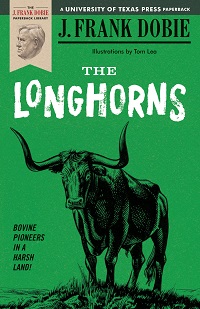 The Texas Longhorn made more history than any other breed of cattle the world has known. These wiry, intractable beasts were themselves pioneers in a harsh land, moving elementally with drouth, grass, Arctic blizzards, and burning winds. Their story is the bedrock on which the history of the cow country of America is founded.
J. Frank Dobie was a tale spinner who appreciated the proper place of legend and folklore in history. In The Longhorns, he tells of the Spanish conquistadors, who brought their cattle with them; of ranching in the turbulent colonial times; of the cowboy, whose abandon, energy, insolence, and pride epitomized the booming West. He writes of terrifying stampedes, titantic bull fights on the range, ghost steers, and encounters with Indians.
A tireless prospector of the history and legends of the Southwest, Dobie spent most of his life preparing to write this book. He was born in the Texas brush country where the Longhorns made their last stand; he back-trailed them into Mexico; he pursued the vivid lore of Texas cowboys and Mexican vaqueros. No historian or naturalist has ever so related an animal to the land, its people, and its history.
Other books by the author:
Apache Gold and Yaqui Silver
Cow People
Coronado's Children
Ben Lilly Legend, The
Bob More: Man and Bird Man
I'll Tell You a Tale
Flavor of Texas, The
Legends of Texas Vol 1
Legends of Texas Vol 2
Longhorns, The
Mustangs, The
Mustangs and Cow Horses
Tales of Old Time Texas
Vaquero of the Brush Country, A