Search
BlogRead the Latest News
Texas Authors Institute of History
A Unique Museum that saves history, inspires the future, depth and gives to the present..

- Details
- Written by Super User
Citation
The following, adapted from the Chicago Manual of Style, 15th edition, is the preferred citation for this article.
William E. Bard, "ADAMS, WALTER R.," Handbook of Texas Online (http://www.tshaonline.org/handbook/online/articles/fad08), accessed March 19, 2015. Uploaded on June 9, 2010. Published by the Texas State Historical Association.
- Details
- Written by Super User
PRIMER, SYLVESTER (1842–1912). Sylvester Primer, Civil War soldier and scholar of Germanic languages, was born in Geneva, Wisconsin, on December 14, 1842, the son of Archibald and Eleanor (Jacoby) Primer. During the Civil War he served in the 108th New York Infantry for one year and in the Fifteenth New York Cavalry for two years. He participated in twenty-three battles and was wounded at Antietam. Primer earned a B.A. degree from Harvard in 1874, and then attended universities in Leipzig, Göttingen, and Strassburg, where he received a Ph.D. degree in philology in 1880. From 1881 to 1889 he taught at the College of Charleston, South Carolina. He taught at Friends School, Providence, Rhode Island, in 1889–90 and at Colorado College, Colorado Springs, in 1890–91, when he resigned to become professor of Germanic languages at the University of Texas. Primer's published works include Die Consonantische Deklination in den germanischen Sprachen (1880), and annotated editions of Lessing's Minna von Barnhelm (1889), Lessing's Nathan der Weise (1894), and Goethe's Egmont (1898). Primer married Lula Martha Muckenfuss on September 17, 1895; they had one son. Primer was a Methodist and a Democrat. He had memberships in the Modern Language Association of America and the Texas Academy of Scienceqv, and was an organizer of the Austin chapter of Phi Beta Kappa, which he served as treasurer and secretary for several years. He died in Austin on August 13, 1912, and was buried in Oakwood Cemetery.
The New Encyclopedia of Texas (4 vol. ed., 1929). Vertical Files, Dolph Briscoe Center for American History, University of Texas at Austin. Who Was Who in America, Vol. 1.
Citation
The following, adapted from the Chicago Manual of Style, 15th edition, is the preferred citation for this article.
William E. Bard, "ADAMS, WALTER R.," Handbook of Texas Online (http://www.tshaonline.org/handbook/online/articles/fad08), accessed March 19, 2015. Uploaded on June 9, 2010. Published by the Texas State Historical Association.
- Details
- Written by Super User
Prince Hall Freemasonry in the Lone Star State
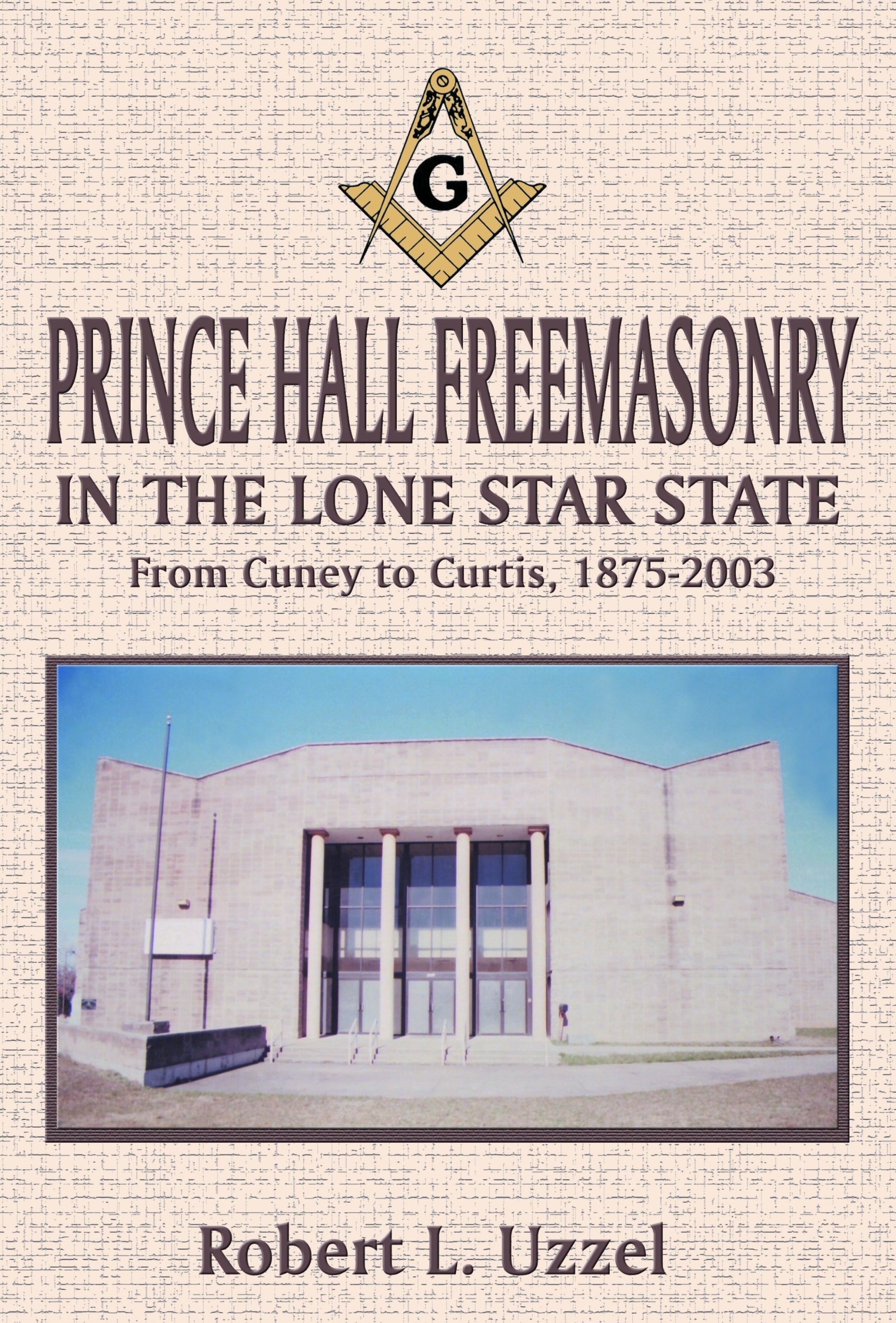
by Robert Lesley Uzzel
Eakin Press
308 pages
ISBN: 978-1571688347
(c) 2004
First Edition
Freemasonry is one of the world s oldest fraternal organizations. It is a society of men concerned with moral and spiritual values. Members are taught its precepts by a series of ritual dramas that follow ancient forms and employ the symbolism of stonemasonry. Assuming its present form in England during the 18th century, Freemasonry came to America with the colonists, and Freemasons have played many roles in American history.
When the author first inquired about the admission of African Americans to Masonic lodges, he was told: They have their own lodges. He later learned that white Masons viewed black Masons not as separate but equal but as irregular and clandestine. Nevertheless, he also learned that members of the predominantly black Prince Hall Masonic Grand Lodges have held their heads high and practiced the ancient mysteries for over two hundred years.
There is now light at the end of the tunnel. Since 1989, thirty-seven mainstream (white) Grand Lodges have extended fraternal recognition to their Prince Hall counterparts. It is our hope that we will eventually see the end of the contradiction of a color line in an organization dedicated to the Fatherhood of God and the Brotherhood of Man.
History of the Book:
The study of fraternal organizations has long been a passion for me. I am impressed by the fact that, since 1875, the Prince Hall Grand Lodge of Texas has done much to uplift humanity and has been a very positive influence in the African American communities of the Lone Star State. It is my desire that my readers be inspired and blessed as they learn about the legacy of a great fraternity.
Robert Lesley Uzzel - March 30, 2015
Citation
Above was provided by the author.
- Details
- Written by Super User
The 1st Place winner and Honorable Mentions will be able to read their work in front of an audience at Best Little Horror Con in Texas 2020.
1st Place Winner
The 1st Place Winner will receive a $500 Scholarship, publication in the Best Little Horror Con in Texas Anthology of Horror 2020, and three copies of the printed book.
Honorable Mentions
Honorable Mentions will be published in the Best Little Horror Con in Texas Anthology of Horror 2020, and one copy of the printed book
The 1st Place Winner and the Honorable Mentions may read their work in front of an audience at Best Little Horror Con in Texas. They may also participate in a book signing event at the ScaryDad Haunted Halloween Show taking place in October.