Search
BlogRead the Latest News
Texas Authors Institute of History
A Unique Museum that saves history, inspires the future, depth and gives to the present..

- Details
- Written by Super User
SCARBERRY, ALMA SIOUX (1899–1990). Alma Sioux Scarberry, writer and radio producer, was born on June 24, 1899, in Carter County, Kentucky, to Rev. George W. and Caledonia (Patrick) Scarberry. Her mother's death when Alma was seven contributed to her relative independence during childhood. She began door-to-door sales work at the age of ten. Upon completing high school and courses at a New Bethlehem, Pennsylvania, business college, she took sales-demonstration jobs in several cities, working her way toward Brooklyn, New York. She joined the United States Navy at eighteen and served during World War I as a secretary in the Brooklyn Fleet Supply Base. Having acquired brief newspaper experience earlier, she began ghost-writing various syndicated columns for King Features after her navy stint. When the New York American offered an opportunity to write under her own byline in 1922, she moved to that newspaper and conducted feature interviews and crime reports. In 1922 she obtained a singing role in Irving Berlin's Music Box Revue at the Shubert Theater in New York, where she performed into 1923. She also appeared in a Shubert production of The Mikado. Meanwhile, her journalism career continued, first at the New York Graphic, Bernard McFadden's sensational tabloid, then at the New York Mirror. From 1926 to 1928 she produced columns and feature articles for the Pittsburgh Sun-Telegraph. She interviewed numerous celebrities, including broadcaster Lowell Thomas, aviator Charles Lindbergh, and baseball star Babe Ruth. In 1929 she began writing romance stories for publication, many of them first serialized in North American, Australian, and British newspapers. Her books, including The Flat Tire, Dimpled Racketeer, Thou Shalt Not Love, Too Wise to Marry, and The Lady Proposes, were first distributed by such companies as Central Press Association, North American Newspaper Alliance, and Ledger Syndicate. She sold stories to the Bell Syndicate throughout the 1930s and completed fifteen books and three more serialized stories between 1929 and 1942.
At the age of 30, Alma Scarberry married Theodore Klein, a United States military officer, but she continued using her maiden name in bylines. She took journalism assignments until her son's birth in May 1932. While caring for him, she adapted her book The Flat Tire to a screenplay, Hired Wife, from which the Pinnacle production company made a film in 1934. In 1937 and 1938 Alma and her child, Ted, Jr., lived in Washington, D.C., where she worked as a columnist for the Washington Herald-Times. She took the boy to Chicago in 1938 and divorced Klein in 1939. Scarberry supplemented her income from syndicated stories by writing scripts, producing radio programs, and managing publicity for a clothing designer. In 1940 she moved to Kansas City, Missouri, and became the publisher's assistant and columnist at the Kansas City Journal. When that newspaper closed in 1941, she moved with Ted, Jr., to Los Angeles, where she combined freelance syndicated writing with publicity and script assignments for CBS Radio, followed by staff writing for the Mutual Don-Lee (Radio) Network, based in Hollywood. She also wrote songs for Western crooner Woodward Maurice (Tex) Ritterqv, who performed her tune "Gonna Lasso a Rainbow for You" in the feature film Cowboy Canteen. She moved back to New York in 1944 and did public relations work for several charities. In 1946 she assumed the directorship of the National War Fund Radio Bureau for a year, then wrote commentary for WNJR, the Newark News radio station, until spring of 1949.
That year, she moved to San Antonio, where her son had been living. For two years, she operated the Scarberry School of Creative Writing and Radio in San Antonio. After a brief stint managing publicity in Dallas, she took a civilian position as a soldier-show technician in Camp Chafee, Arkansas, during the Korean War. About 1953 she moved to Columbus, Ohio, where she supervised fund drives for two large charity organizations. She became public-relations director for Columbus Plastics Products in 1959 and remained with the firm until 1965. In Columbus she continued to write fiction, including a children's-story series about the Doofer Family. She subsequently left Columbus Plastics Products and returned to Texas to be near her son in Austin. She served as publicity director of Goodwill Industries before transferring to a public-relations post for the Austin Parks and Recreation Department's senior programs. In 1983 she retired from the department, but continued as a volunteer to assist elderly persons by publicizing the Experience Unlimited job-training program and the Old Bakery and Emporium. Still a spirited performer, she appeared in television commercials and theatrical productions and was a frequent guest on the Cactus Pryor talk program on KLBJ-AM radio. A stroke in November 1989 limited Scarberry's activities and contributed to her death, on April 10, 1990. Her ashes were buried at her son's home at Lake Travis, near Austin.
American Women (Teaneck, New Jersey: Zephyrus Press, 1974). Robyn Turner, Austin Originals: Chats with Colorful Characters (Amarillo: Paramount, 1982). Who's Who of American Women, 1977–78. Women in Media Collection, Western Historical Manuscript Collection, University of Missouri.
Citation
The following, adapted from the Chicago Manual of Style, 15th edition, is the preferred citation for this article.
William E. Bard, "ADAMS, WALTER R.," Handbook of Texas Online (http://www.tshaonline.org/handbook/online/articles/fad08), accessed March 19, 2015. Uploaded on June 9, 2010. Published by the Texas State Historical Association.
- Details
- Written by Super User
Author Tammy Burrow Schrecengost offers a second glimpse of Big Spring in a collection featuring images from the extensive photographic archives of the Heritage Museum of Big Spring and from private collectors. Schrecengost is currently curator of the museum.
Citation
From Amazon.com as of December 21, 2015
Books by the Author:
- Details
- Written by Super User
Author Michele Packard
Scoochie-Scoochie Nite-Nite
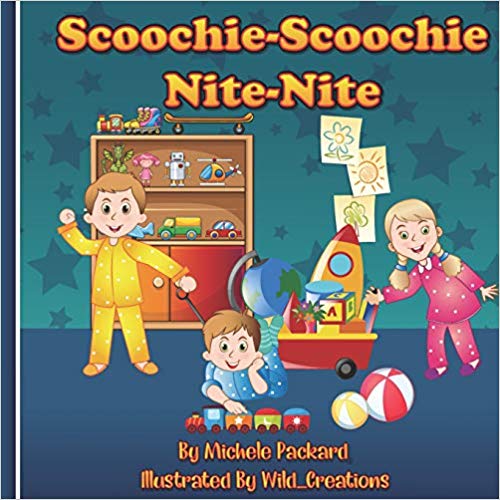
A lovable night time story to read to young children