Search

BlogRead the Latest News


Texas Authors Institute of History

A Unique Museum that saves history, inspires the future, depth and gives to the present..

Dana Wayne

Buy Book

$12.99


Points to Purchase:130
Points Earned:12
Bonus Points Earned:0


Nurse Tori Morgan needs to regroup following a personal tragedy. Seeking refuge, she accepts a position at a remote ranch in Montana. Firmly convinced love happens once in a lifetime, she resigns herself to being alone. And then she meets her new boss. Wade McBride is six feet four inches of man capped off with a potent sexuality that makes clear thinking difficult. To make matters worse, she discovers she must pretend to be his fiancée for the sake of her new patient. Wade needed a nurse for his mother but got more than he bargained for in Tori. She was a breath of fresh air in world full of crap. Pretending to be in love with her seemed like a good idea at the time. The plan starts out easy enough even as they try to ignore the electricity radiating between them, unware of danger watching from the shadows. The test kiss changes everything. Once was not enough for Wade. Tori is convinced his mouth should be registered as a lethal weapon. But is she ready for this? Will she ever be ready? They dance around the elephant in the room until they have to ask themselves…what happens when make believe becomes real? Purchase Dana Wayne's book today in ebook and paperback.

Author: Larry Farmer

Seeing Gail Again

$12.99


Points to Purchase:130
Points Earned:13
Bonus Points Earned:0


Synopsis
Jericho, just out of the Marines, returns to his roots in Texas only to face the anti-war movement that demonizes all Vietnam vets. He needs to sort through his life away from all that, and in his travels he stumbles upon a Shangri-La called the Lake District of England. There is peace and serenity around those lakes. And a girl—a beautiful, soulful girl he meets while working in the restaurant of a luxury hotel. Gail is deep and intellectual, a mother-earth type who gives him peace inside. But when the Yom Kippur War breaks out in Israel, he abruptly leaves her and goes to help the beleaguered Jewish state while seeking his Jewish identity. Yet neither Jericho nor Gail could ever forget the depth of their love… Will meeting again, years later, resolve the feelings that never left them?

BuyBook

SEELE, FRIEDRICH HERMANN (1823–1902). Hermann Seele, teacher, public official, writer, and cultural leader, son of Jonas and Anna (Runge) Seele, was born in Hildesheim, Hannover, Germany, on April 14, 1823. He was educated at the Andrenaeum Academy in Hildesheim and subsequently immigrated to Texas.

After landing at Galveston on December 12, 1843, he joined the Adelsverein (a colonization society of German nobles) and arrived in May 1845 in the month-old city of New Braunfels, which became his home for the rest of his life. Pastor Louis Cachand Ervendberg, the spiritual leader of the New Braunfels colony, chose Seele to teach the colony's first school, and the community still remembers Hermann Seele as its first teacher. His law career began when he was elected the first Comal County district clerk in 1846. He was admitted to the bar on April 27, 1855. He was active on behalf of the Democratic party and opposed the American (Know-Nothing) party, a nativist, xenophobic, anti-Catholic movement. During the Civil War he served as adjutant and inspector general of the Thirty-first Brigade, Texas Militia, with the rank of major. Concurrently he served as mayor of New Braunfels. He married Mathilde Blum on January 25, 1862, and to them were born three sons and two daughters. From 1863 to 1865 Seele served in the Tenth Texas Legislature.

After the Civil War he turned his energies to education and served as a member of the board and faculty of New Braunfels Academy until 1879. In 1871 he organized the first state Teachers Conference, and when in 1872 the Texas State Board of Education (see TEXAS EDUCATION AGENCY) mandated the formation of teachers' institutes, Seele's school served as a model. To Seele's influence is attributed the fact that Jacob Waelder was able to include in the Constitution of 1876 a section establishing independent school districts empowered to finance public schools through taxation.

In the fall of 1876 Seele, as attorney, had to give his full attention to the suit of the Veramendi heirs, who sought to gain title to the Comal tract, upon which New Braunfels is built. Seele, who had first joined in defending the New Braunfels citizenry in 1852 against the Veramendi claim, succeeded on April 23, 1879, in winning a decision in the citizens' favor in the United States Circuit Court (see VERAMENDI ESTATE). He became postmaster in New Braunfels on October 1, 1889, and served until February 28, 1895. He was a charter member of the First Protestant Church of New Braunfels. He was elected secretary of the congregation in 1845 and served until his death, when he was succeeded by his son Harry. On occasion Seele also served as lay preacher.

As a member of the Germania Singing Society (see TEXAS STATE SÄNGERBUND), he helped organize the first and subsequent Saengerfeste (singing festivals) throughout Texas. Seele's Sängerhaus (singers' hall), a thirty-by-eighty-foot brick structure built in 1855 beside the Comal River, was a center not only for singers but also for the New Braunfels Dramatic Society, in which Seele participated. He was also a writer of both verse and prose. He was regularly called upon for stanzas to grace birthdays, weddings, and other social and civic events.

In 1851 Ferdinand Jacob Lindheimer, the great Texas botanist, founded and edited the Neu Braunfelser Zeitung. Seele participated in the founding, contributed to the newspaper's columns, and later had editorial control. In 1936 his descendants privately published a collection of his writings, Die Cypresse und Gesammelte Schriften. An English edition, The Cypress and Other Writings of a German Pioneer in Texas, was published by the University of Texas Press in 1979.

Seele died in New Braunfels on March 18, 1902. In 1936, as part of the Texas Centennial celebration, a monument honoring Seele was erected in Landa Park in New Braunfels. In 1954 his portrait was included in a painting, The Heroes and Heroines of Texas Education, commissioned by the Texas Heritage Foundation. In 1976 a marker recounting his achievements was placed on the Sophienburg Museum and Archives grounds, and in Landa Park a large monument named him among the early settlers. The Sixty-fifth Texas Legislature designated April 14, 1977, Hermann Seele Day, and his church named its activities building the Seele Parish House.

BIBLIOGRAPHY: 

Rudolph L. Biesele, The History of the German Settlements in Texas, 1831–1861 (Austin: Von Boeckmann-Jones, 1930; rpt. 1964). Oscar Haas, History of New Braunfels and Comal County, Texas, 1844–1946 (Austin: Steck, 1968).

Edward C. Breitenkamp
 

Citation

The following, adapted from the Chicago Manual of Style, 15th edition, is the preferred citation for this article.

William E. Bard, "ADAMS, WALTER R.," Handbook of Texas Online (http://www.tshaonline.org/handbook/online/articles/fad08), accessed March 19, 2015. Uploaded on June 9, 2010. Published by the Texas State Historical Association.


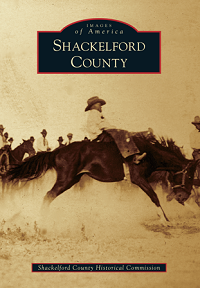
Author: Shackelford County Historical Commission
Publisher: Arcadia Publishing
Retail:
 $21.99
ISBN: 978-1467131186
Copyright: April 2014
Pages:
 128

One-hundred-fifty miles west of Dallas, on a gently rolling prairie that was once the predatory domain of the Plains Indians, lies Shackelford County. Anglo-American settlers began arriving in the 1850s to raise livestock and cultivate crops near the Clear Fork of the Brazos River. To protect the settlers from the Indians, the US Army established Fort Griffin in 1867. In true Wild West fashion, the raucous town of Fort Griffin sprang up nearby to service the soldiers, cattle drovers, and buffalo hunters. In 1874, Albany became the county seat, and with the arrival of the Texas Central Railroad in 1881, then the oil and gas boom in 1910, both Albany and Moran flourished while Fort Griffin folded. Today, Shackelford County’s economy is based on cattle ranching, farming, petroleum, and hunting. Visitors enjoy shopping Albany’s beautifully restored Main Street and taking in the Old Jail Art Center, the stately limestone courthouse, the Fort Griffin State Historic Site, and the Fort Griffin Fandangle.

Site Menu