Search

BlogRead the Latest News


Texas Authors Institute of History

A Unique Museum that saves history, inspires the future, depth and gives to the present..

Author: Rick Sherrod, Foreword by G.A. Moore
Publisher: The History Press
Retail:
 $19.99
ISBN: 978-1609496128
Copyright: August 2013
Pages:
 167

Since the first annual state football champion was crowned in 1920, Texas has never been the same. Today, millions of Texans gather in stadiums across the Lone Star State, eagerly awaiting that magical mid- to late-December moment when the season comes to its dramatic conclusion. Of the 391 high schools reaching the championship matchup, only a handful--26--have won the title four times or more, laying claim to the coveted moniker "dynasty." From Waco High School's fourth title win in 1927 to Stamford's fourth official win in 2012, writer and lifelong football enthusiast Rick Sherrod traces the "best of the best" in this pigskin empire across ninety-three action-packed seasons.

Rick Sherrod teaches history at Stephenville High and is the author of two previous titles as well as a number of pieces for state historical journals. G. A. Moore is the winningest high school coach in Texas football history. Over the course of 45 years Moore served as head coach at Bryson, Pilot Point, Celina, Sherman, and Aubrey. He is credited with 423 victories.


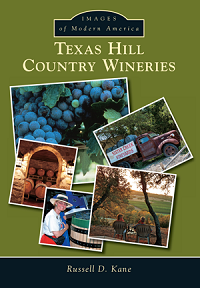
Kane, Russell D

Author: Russell D. Kane
Publisher: Arcadia Publishing
Retail:
 $22.99
ISBN: 978-1467132732
Copyright: January 2015
Pages: 96

The Texas Hill Country wineries have roots as old as any around. Texas grapes grow in soils made from ancient sea deposits, similar to the grape-growing regions of Europe. Texas wine culture arrived in the 1600s with Spanish missionaries who settled and planted vineyards in El Paso del Norte. The 1800s brought German and Italian immigrant farmers to Texas; they considered wine a staple of everyday life. In what is now America’s No. 5 wine-producing state, the Texas Hill Country was named by Wine Enthusiast magazine to its 2014 list of best international wine destinations. It may surprise some, but not the wine aficionados who have visited the Texas Hill Country’s 50 or more wineries, that wine-and-culinary tourism is currently the Texas Hill Country’s fastest growing sector. This book is your guide to the Texas Hill Country winery experience. It is time to sip and savor Texas for yourself.
 

Books by the Author:

Texas Hill Country Wineries

Wineslinger Chronicles: Texas on the Vine, The


TEXAS INSTITUTE OF LETTERS. The organizational meeting of the Texas Institute of Letters convened in the lecture room of the Hall of State on the grounds of the Texas Centennial Exposition in Dallas on November 9, 1936. The idea for the organization came from William H. Vann, a professor of English at what is now the University of Mary Hardin-Baylor, in Belton. He and others had been inspired by the celebration of the Texas Centennial to form an organization to promote interest in Texas literature and to recognize literary and cultural achievement. J. Frank Dobie spoke at an evening session on "The Earth Remembers." Advocating that Texas authors write on Texas subjects, he reminded his audience that "great literature transcends its native land, but there is none that I know of that ignores its own soil." Fifty Texans composed the charter list of members, but two of them, Fannie E. Ratchford and Donald Joseph, declined acceptance. Dobie himself at first expressed doubt about the worth of the organization, but after he had become a member he devoted himself to the work. Cokesbury Bookstore in Dallas became an early supporter of the organization and in 1938 began sponsoring annual meetings there. The first book award, in 1939, went to Dobie for Apache Gold and Yaqui Silver. In 1946 Carr P. Collins began funding an award of $1,000 for the best Texas book of the year, defined as one on a Texas subject or by a Texas author. Later, this became the nonfiction award when the Jesse H. Jones prize for the same sum was offered by the Houston Endowment for the best book of fiction. Both awards have continued to the present, in increased amounts. Awards funded by other individuals and organizations for poetry, short stories, scholarly authorship, journalism (with emphasis on writing quality), children's books, and book design have been given. Fifty years after its founding, the institute awarded more than $11,000 annually. Starting in 1967 the institute cosponsored, with the University of Texas at Austin, Dobie-Paisano fellowships consisting of six-month stays, with stipends, at Dobie's 265-acre retreat, Paisano Ranch. With the exception of Katherine Anne Porter, most established Texas writers since 1936 have been associated with the Texas Institute of Letters. Apparently because of Porter's chosen disassociation from the state, she never accepted membership. Membership is offered to persons associated with Texas who have been nominated by a member, approved by the council, and elected by the active members. Election is permanent, although only dues-paying members are listed as active and kept on the mailing list for the quarterly newsletter. The institute, whose official address varies according to residence of the secretary-treasurer, meets each spring to present awards and transact business. The sole source of institute income is dues, which are nominal, and outside contributions. The members are novelists, poets, essayists, historians, journalists, playwrights, and other writers, but the emphasis for membership has always been on authorship of quality.

BIBLIOGRAPHY: 

Dallas Morning News, March 19, 1986. William H. Vann, The Texas Institute of Letters (Austin: Encino, 1967). John Edward Weems, "History of the Texas Institute of Letters," Texas Libraries 45 (Spring 1986).

John Edward Weems


Citation

The following, adapted from the Chicago Manual of Style, 15th edition, is the preferred citation for this article.

William E. Bard, "ADAMS, WALTER R.," Handbook of Texas Online (http://www.tshaonline.org/handbook/online/articles/fad08), accessed March 19, 2015. Uploaded on June 9, 2010. Published by the Texas State Historical Association.


TEXAS MAGAZINE, DALLAS. The Texas Magazine was published in Dallas in August 1897, with William G. Scarff as editor and publisher and Dudley Goodall Wooten as editorial supervisor. During its publication of less than a year, the magazine covered a wide range of interests, including literature, current events, women's clubs, and poetry. Historical articles were contributed by Oran Milo Roberts, Adele Lubbock Briscoe Looscan, and John Avery Lomax. The issue of April 1898 was the last publication of the Texas Magazine in Dallas, although in the February-March issue of the literary magazine Gulf Messenger, a merger was announced for the two magazines.

BIBLIOGRAPHY: 

Imogene Bentley Dickey, Early Literary Magazines of Texas (Austin: Steck-Vaughn, 1970).


Citation


The following, adapted from the Chicago Manual of Style, 15th edition, is the preferred citation for this article.

William E. Bard, "ADAMS, WALTER R.," Handbook of Texas Online (http://www.tshaonline.org/handbook/online/articles/fad08), accessed March 19, 2015. Uploaded on June 9, 2010. Published by the Texas State Historical Association.


Site Menu