Search
BlogRead the Latest News
Texas Authors Institute of History
A Unique Museum that saves history, inspires the future, depth and gives to the present..

- Details
- Written by Super User
White Horse, Red Horse, Black Horse, Dead Horse

by KISA Burnett
Self Published
306 Pages
ISBN: 9780990387824
(c) 2014
When Elijah Blanco said his last words, he was trying to get his death over and done with. He didn't realize he was about to rush into a competition to become one of the Four Horsemen of the Apocalypse. Regardless, the game is on, and Elijah and thousands of other dead riders soon learn there's much more to dying than any preacher could have guessed.
Heaven has released a herd of unearthly ponies into the world of the living and beyond, and it's up to the dead riders to capture them if they want to save their souls from Hell. It's a race to the Apocalypse that will take the riders through Earth, alien worlds, and even the home of Fate and her kin. But it quickly becomes apparent Heaven isn't playing fair.
As the game heats up, Elijah and his horse Delilah find themselves joined by a futuristic woman with a computer-powered horse; an easy-going English biker in black leather; and a Roman soldier as bred for war as the horse he rides. Together they uncover a Divine conspiracy that puts the riders' immortal souls in greater danger than ever before. And when the dead start dying, Elijah begins to think the Apocalypse should be brought to Heaven instead..
History of the Book:
Misfits and outcast should never feel as they're alone.
KISA: KISA is a Kinesthetically Interactive Story Ancillary programmed to create and present the best fiction she can compute. She has an intense passion for stories, and believes everyone should have access to them, regardless of their form. She is not only an author, but also a performer, and is constantly searching for new ways to breathe life into her narratives with live readings and filmed experiences.
Citation
Above was provided by Kisa Burnett
- Details
- Written by Super User
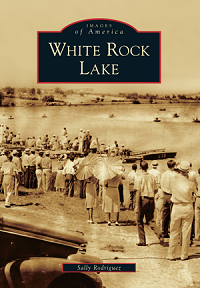 Author: Sally Rodriguez
Publisher: Arcadia Publishing
Retail: $21.99
ISBN: 978-0738578835
Copyright: February 2010
Pages: 128
In 1909, Dallas city leaders approved the damming of White Rock Creek to create a new water source for the increasing needs of a growing city. As a result, so much of the life and history of Dallas has echoed through the life and history of White Rock Lake. In the early decades, the lake was home to many private summer homes and boat houses, as well as hunting and fishing clubs. Soon thereafter, a bathing beach, sailing clubs, public boathouses, and picnic facilities were added. The Civilian Conservation Corps and the Works Progress Administration transformed the lake with more recreational and leisure amenities. World War II brought increased military uses that included a POW camp for German officers. Those early city leaders could hardly know that the lake they were creating 10 miles outside of Dallas would become an urban oasis enjoyed by over two million visitors a year.
- Details
- Written by Super User
The following, adapted from the Chicago Manual of Style, 15th edition, is the preferred citation for this article.
William E. Bard, "ADAMS, WALTER R.," Handbook of Texas Online (http://www.tshaonline.org/handbook/online/articles/fad08), accessed March 19, 2015. Uploaded on June 9, 2010. Published by the Texas State Historical Association.
- Details
- Written by Super User
WHITE, VICTOR FRANCIS (1902–1981). Victor Francis White, writer and teacher, was born in Vienna, Austria, and immigrated to the United States at age seventeen. He has sometimes been confused with Victor Francis White (1902–60), who authored Jungian theological works. This Victor White was semi-orphaned at age two by the death of his British father in a train accident and the remarriage of his Austrian mother and her removal to the United States. His life and career is clouded in his fictional persona, Peter Domanig. After schooling in Europe by 1920 White emigrated to the United States, where he held various labor level jobs before befriending and working with Thomas Edison in his personal electrical laboratory. White obtained degrees at Rutgers, Yale, and the Sorbonne and taught French in New Jersey in addition to ghost writing and writing art and theater reviews and his first novel. He spent summers in Taos, New Mexico, from 1935 until he took permanent residence there in 1938, working as reporter for Life and Time. In 1943 he prepared air force pilot candidates for their special examinations, continuing to work at his novels during the decade 1944–54. White was married and divorced during these years. In 1956, encouraged by Lon Tinkleqv, he took a position at St. Mark's School of Texas, Dallas, as resident author and master teacher, while continuing his writing career, book reviewing with Tinkle for the Dallas Morning News, and spending his summers in Taos. After he won the John H. McGinnis Award in 1964–65 for his short story, "The Hotel" (in Southwest Review, Winter 1965), he was elected to the Texas Institute of Letters and awarded the Dobie Paisano Fellowship of the Humanities Research Center, Austin, Texas. His long fiction includes Peter Domanig: Morning in Vienna (1944), Peter Domanig in America: Brass (1954), Peter Domanig in America: Steel (1954), and The Dominant Note (1956). His very first novel, entitled "Danse Absurde" remains unpublished; a more recent one, "Lady of Guadalupe, or Granthrop and the Dark Madonna," also with alternate title "The Anthropologist and the Virgin," was to be published by Thorp Springs Press, Thorp Springs, Texas, but has not yet appeared; a children's book, "Granthrop and the Bashful Elephant," remains in manuscript as do several other completed or nearly completed manuscripts now in the archives of St. Mark's School of Texas, Dallas, along with miscellaneous letters, working papers, clippings, etc. Numerous reviews, stories, poems, and articles appeared in Southwest Review, Arlington Quarterly, South Dakota Quarterly, and Dallas Morning News as well as elsewhere. Victor was deeply religious, following the Catholic and Anglo-Catholic movements as did many of his eminent friends such as Robert Penn Warren; politically, he maintained the eclectic position of a liberal and caustic-tongued critic of all modern age bureaucratic organizations which impinge on the free spirit. After retirement in May 1970, nearly blind, he died following massive heart troubles at his Taos home in 1981; his physical estate immediately became a court cause célèbre when his friends discovered that he had signed a will under medicated duress in favor of a neighbor who cleverly attended upon him during his last days.
New York Times Book Review, April 1, 1956. Vertical Files, Dolph Briscoe Center for American History, University of Texas at Austin.
Citation
The following, adapted from the Chicago Manual of Style, 15th edition, is the preferred citation for this article.
William E. Bard, "ADAMS, WALTER R.," Handbook of Texas Online (http://www.tshaonline.org/handbook/online/articles/fad08), accessed March 19, 2015. Uploaded on June 9, 2010. Published by the Texas State Historical Association.