Search
BlogRead the Latest News
Texas Authors Institute of History
A Unique Museum that saves history, inspires the future, depth and gives to the present..

- Details
- Written by Super User
William T. (Bill) Harper is not a native Texan but, as those native Texans say, he is one who “got here as fast as he could.” In Bill’s case, however, that was pretty slow. He came to the Lone Star State’s Gulf of Mexico from Lake Superior on a sail-less sailboat along 2,400 miles of the Nation’s inland waterways. A former newspaper reporter/editor (The Philadelphia Inquirer) and a writing teacher for the city of College Station, Texas, Bill’s first book (Eleven Days in Hell, University of North Texas Press) was honored by the Writers League of Texas as the best in non-fiction for 2005. He also has his own weekly program on Texas A&M University’s public radio station, KAMU-FM. Harper came to journalism early in life. He was 15 when he started his “real” working career at what was then called a “copyboy” position at The Inquirer. After an ensuing award-winning association management career, via which the Mayor of Minneapolis proclaimed the City’s striking new Convention Center would “not have been built were it not for Bill Harper,” he did “go home again” when he turned author in his early retirement. Along the way, his life was in itself “one for the books.”
A high school dropout – who went on to earn BA and MBA degrees – he fathered six children, three boys and three girls. (He denies it was a “planned parenthood.”) He spent five years, one month, and 11 days in the U.S. military, all but basic training in a branch of the CIA. Harper was assigned to the Army, the Navy, and to the Air Force. “Nobody wanted me,” he says with a grin on his face. A most memorable part of his military duty was his participation in “Operation Ivy,” the firing of the world’s first H-bomb at Eniwetok Atoll in the Pacific Ocean.
As he was an observer at the birth of the Hydrogen Age, so too was he at the launching of Apollo 11 – which sent Neil Armstrong, Buzz Aldrin and Michael Collins to history’s first landing on the moon. Harper bantered with JFK at press conferences and chatted with HST in his Independence, Missouri library. He has also stood in a supermarket checkout line with Bush 41.
He was an avid sail-boater on the Great Lakes and beyond, a prize-winning skipper/owner of Harper’s Ferry in a number of 400-mile, Trans-Superior sailboat races. A somewhat less frantic trip was his 2,400-mile odyssey in his 47-foot sailboat through three of the Great Lakes, the Illinois and Mississippi rivers, and the Gulf of Mexico. It took Harper from his old home in the Twin Cities of Minnesota to a somewhat smaller version, his retirement home in College Station, Texas.
Early in his early retirement, Harper stumbled upon a story he thought had to have been almost over-written. As it turned out, it never was completely covered – even though at the time it was only overshadowed on the national television newscasts by President Nixon’s resignation. Harper’s discovery turned into Eleven Days in Hell: The 1974 Carrasco Prison Siege in Huntsville, Texas. It won the Violet Crown Award presented by the Writers League of Texas as the “Best in Texas Non-Fiction for 2005.”
Another bit of journalistic recognition came his way in 2012 when his widely acclaimed Second Thoughts: Presidential Regrets with their Supreme Court Nominations was named an Honors Selection by the indie-publishers organization, B.R.A.G. Lawyers reading it have claimed it contains lessons “they never taught me in law school.”
His book on the perils and prizes of tow-boaters’ lives, The Rivers of Life - and Death, has been adopted by the National Mariners Association as a handbook for tow-boat operators. The media-labeled “author-historian” isn’t always in the grim world of prison sieges or life-and-death rivers (or in a prison death house as is covered in his An Eye for An Eye). In August of 2012, he published HOW COME? 96 Unanswerable Questions – such as, “HOW COME the ‘mirror, mirror on the wall’ never comes up with the right answer?!”
- Details
- Written by Super User
William J Chambers
 Author: William J Chambers
Publisher: All About Cutting
Retail: Not Available
ISBN: 978-0981490380
Copyright: November 2011
Pages: 288
In this tale of Alaska, two young men come to Prince of Wales Island: one, a whaler who in 1849 was shipwrecked on the island's southern rocky shore, and one who arrived by ferry in the summer of 1975 to search for his place in the grand scheme of things. Their two lives were forever changed by the adventure awaiting them. True, they were from different times but their stories were played on the same incredible stage against a backdrop rich in mystical folklore and native history. And whether by fate or chance, their lives became tied together.
- Details
- Written by Super User
WILLIAMS, CLAYTON WHEAT (1895–1983). Clayton Wheat Williams, engineer, military officer, geologist, oilman, rancher, civic leader, historian, and philanthropist, the fourth child of Sallie (Wheat) and Oscar Waldo Williams, was born in an officers' building of the abandoned Fort Stockton in the town of Fort Stockton, Texas, on April 15, 1895. He attended Fort Stockton public school and Texas A&M, where he obtained a degree in electrical engineering in 1915. During the next two years he worked as an electrician for a mining company in New Mexico. In 1917 he joined the first Officers' Training Camp at Leon Springs, Texas, received a commission as a second lieutenant from Fortress Monroe Artillery School in Virginia, and then volunteered for military duty in France, where he received additional training in artillery warfare. Thereafter, until the end of the war, he served as an instructor in military schools in Langres and Cleremont-Ferrand, France. During 1919 and 1920 Williams worked as an engineer for the Oil Belt Power Company in Eastland, Texas, and for the next four years he was a surveyor and an engineer for the highway departments in Texas and New Mexico. In 1924 he became chief engineer for the Texon Oil and Land Company. While thus employed he advanced to the head of the land and geological departments. Despite the fact that he had no formal training in geology, he became one of the earliest licensed geologists in Texas and was responsible for the discovery of the Settles and Harding oilfields in Howard County and for the first oil discovery in the rich Ellenburger formation. He was largely responsible for convincing Texon officials to drill the successful University 1-B well in 1926. It was the world's deepest well at the time. In 1927 he constructed the water and ice works in Crane, Texas, which he operated until 1935.
In 1928 Williams resigned from Texon and on September 10 married Chicora (Chic) Lee Graham of San Angelo; they had two children, Clayton W., Jr., and Janet. Thereafter, he was independently engaged in the oil and ranching business and active in numerous civic and community affairs. As an elected official, he served for twelve years as a Pecos County commissioner and for several years on the Fort Stockton School Board. He was a Scottish Rite Mason and a member of the Methodist Church, the Permian Historical Society, the West Texas Historical Association, the Texas State Historical Association, the Pecos County Historical Commission, the American Legion, and the Veterans of Foreign Wars. Williams also achieved distinction as a regional historian and as a philanthropist. His publications include several scholarly articles and five books: Never Again (3 vols., 1969), Animal Tales of the West (1974), and Texas' Last Frontier: Fort Stockton and the Trans-Pecos, 1861–1895 (1982). Williams gave generously to worthy events and organizations in Fort Stockton; other beneficiaries of his generosity included Texas A&M University, the Permian Historical Society, the West Texas Historical Association, and the Texas State Historical Association. Williams was the recipient of many honors. He was a fellow of the Permian Historical Society, and he served as president of the Fort Stockton Historical Society and the West Texas Historical Association and as commander of the American Legion and VFW posts in Fort Stockton. He was an honorary life member of the Pecos County Sheriff's Posse and the Board of Stewards of the First United Methodist Church in Fort Stockton. His name is engraved on a plaque on the battleship Texas and on the list of "First Campers" in the garden at the Alamo. In 1974 he was named Fort Stockton's Outstanding Citizen, and the West Texas Historical Association Year Book for 1982 is dedicated to him. Clayton W. Williams died on September 9, 1983, and was buried in East Hill Cemetery, Fort Stockton.
Fane Downs, "Clayton W. Williams," West Texas Historical Association Year Book 58 (1982). Samuel D. Myres, The Permian Basin: Petroleum Empire of the Southwest (2 vols., El Paso: Permian, 1973, 1977). Martin W. Schwettmann, The Discovery and Early Development of the Big Lake Oil Field (M.A. thesis, University of Texas, 1941). Who's Who in the South and Southwest.
Citation
The following, adapted from the Chicago Manual of Style, 15th edition, is the preferred citation for this article.
William E. Bard, "ADAMS, WALTER R.," Handbook of Texas Online (http://www.tshaonline.org/handbook/online/articles/fad08), accessed March 19, 2015. Uploaded on June 9, 2010. Published by the Texas State Historical Association.
- Details
- Written by Super User
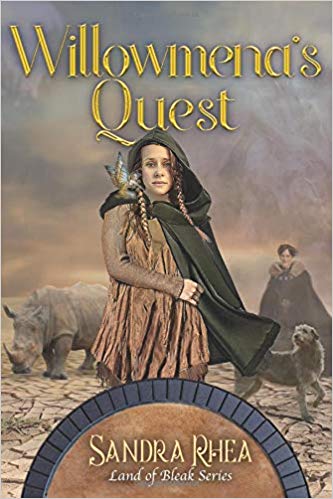
Author Sandra Rhea
Willowmena’s Quest
Synopsis
When a motherless young girl named Willowmena stumbles over Merloo, a fairy with a broken wing, the two become unlikely companions in a barren land where friendship is virtually unknown. Accompanied by a magical rhinoceros with a flashing red eye, a mute prince, and relentlessly pursued by the Miner of the Dark Pass, the stalwart band of travelers embark on a heroic journey through the dusty Land of Bleak. Willowmena and her friends travel in search of the Mountains of Tune, each of them seeking something they need in order to return to the world beyond. As Willowmena finds her role as the Light-Bearer of Bleak, she meets a lost queen, and her evil cousin, whose insatiable greed and envy compel her an unholy alliance with the Miner of the Dark Pass and his pack of ruthless, slovenly wolves. In order to save her country Willowmena must find the gift of her own gold and come to terms with a terrible secret from her past, making her question everything she knows to be true. She must be willing to venture out of Bleak and into the Land Outside, a place of impossible beauty.