Search
BlogRead the Latest News
Texas Authors Institute of History
A Unique Museum that saves history, inspires the future, depth and gives to the present..

- Details
- Written by Super User
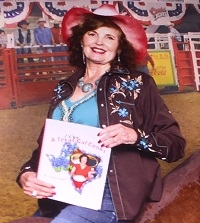
I am truly a Texan. I have lived in the same small town all of my life. I live in an old Victorian house that was built in 1882. Living here is like stepping back in time to another era. It has always been a dream of mine to write a cookbook. Cooking has always been my hobby. I have always loved cooking, and experimenting with recipes, and making my own recipes. I especially love to do decorative cooking. My specialty is baking. I live life to the fullest, and enjoy every beautiful day that is given to me. Life is exciting down here in Texas I have many hobbies. I design, and sew clothes, which is fun. I also do decorative sewing, and monogramming, which I give for gifts. I also love to oil paint landscape scenes, flowers, and animals for relaxation. I studied Interior Decorating at Kings College in London, England. I really enjoy decorating in every aspect of my life.

- Details
- Written by Super User
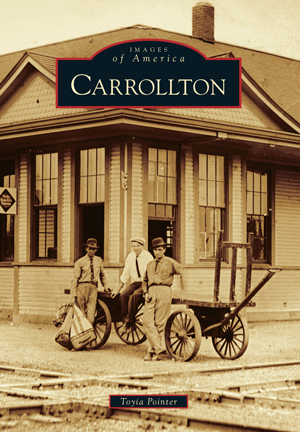 Author: Toyia Pointer
Publisher: Arcadia Publishing
Retail: $21.99
ISBN: 978-0738556376
Copyright: August 2008
Pages: 128
Over 160 years ago, bear and buffalo roamed the prairie and Wichita Indians camped on the banks of the Elm Fork of the Trinity River. Settlers from places like Illinois, Missouri, Kentucky, Tennessee, and as far away as England and Ireland began arriving in North Texas. Texas was not yet a part of the United States when Sam Houston, as president of the Republic of Texas, entered into an agreement with the Peters Colony Company to attract settlers to the area with the promise of free land. Carrollton likely received its name from one of these groups that emigrated from Carrollton, Illinois. The city grew as it became a railroad hub and later transitioned from a rural community to a prosperous Dallas suburb. In 1976, the city participated in many national bicentennial celebrations, and volunteers restored and opened a museum to honor its rural beginnings and courageous settlers.
- Details
- Written by Super User
CARTER, ASA EARL (1925–1979). Asa Earl Carter [pseud. Bedford Forrest Carter], part Indian, segregationist, politician, speech-writer, and novelist, one of five children of Ralph and Hermione (Weatherly) Carter, was born in Anniston, Alabama, on September 4, 1925, and lived near Oxford. He attended schools in Calhoun County, Alabama. He married India Thelma Walker and had four children. Carter served in the United States Navy during World War II and later returned to the University of Colorado, where he attended naval training school in 1944. By the late 1950s he was in Birmingham, Alabama, where his political activities included hosting a radio show for the American States Rights Association and providing leadership in the Alabama Council movement. Later he founded the North Alabama White Citizens Council in Birmingham. He wrote speeches for Lurleen Wallace when she ran successfully for the governorship of Alabama in 1966 and was one of two writers said to be responsible for the words "segregation today, segregation tomorrow, segregation forever" uttered by Governor George Wallace. Although Carter is associated by the media with George Wallace and publicly claimed that he wrote speeches for Wallace in the 1960s, Wallace denied any association or collaboration. Carter ran unsuccessfully against Wallace in the Democratic primary for governor in 1970.
After his loss to Wallace, Carter gave up politics and left Alabama. He adopted the pseudonym Bedford Forrest Carter and assumed the role of a largely self-taught, part-Cherokee novelist named after Nathan Bedford Forrest, the colorful, uneducated Confederate general. Carter also used a Cherokee Indian name, Gundi Usdi, which he translated as Little Tree. So complete was his break with his old life that it was not widely known until after his death that the novelist and the former politician were the same man. By 1972 Carter was in Sweetwater, Texas, where he used the resources of the City-County Library to work on his first novel, Gone to Texas (1973). The highly successful film version starring Clint Eastwood is entitled The Outlaw Josey Wales (1976). Carter's residence during the writing of his three other books was St. George's Island, Florida. These books are The Vengeance Trial of Josey Wales (1976), a sequel to his first novel; The Education of Little Tree (1976, reprint 1986), a purported autobiography of his early years, considered his best book; and Watch for Me on the Mountain (1978), a sympathetic portrayal of Geronimo. Carter received various honors, one of which was an appearance at a Wellesley luncheon in Dallas in 1978 with J. Lon Tinkle, Barbara Tuchman, and Elizabeth Forsythe Hailey. Carter was a masterful storyteller whose prose style is characterized by sparsely phrased, often fragmentary sentences and fast-paced plot. The influence of the Civil War and his Cherokee heritage are evident, and from these he drew his themes of courage, honor, kinship, and blood-feud. He spent his last years traveling to promote his books, attempting to arrange for films of the last three of them, writing the screenplay for one himself, and composing The Wanderings of Little Tree, an unfinished sequel to his third book. In addition, Bruce Marshall, an artist from Austin, prepared illustrations for a volume of Carter's poetry. All of these efforts collapsed with Carter's untimely death. In Abilene, Texas, on June 7, 1979, he choked on food and clotted blood after a fistfight, and died; he is buried near Anniston, Alabama.
BIBLIOGRAPHY:
Birmingham (Alabama) News, April 20, 1970, July 4, 1979. Lawrence Clayton, "The Enigma of Forrest Carter," Texas Books in Review 5 (1983). Lawrence Clayton and Randall Parks, "Forrest Carter's Use of History," Heritage of the Great Plains 15 (1982).
Lawrence Clayton
Citation
The following, adapted from the Chicago Manual of Style, 15th edition, is the preferred citation for this article.
William E. Bard, "ADAMS, WALTER R.," Handbook of Texas Online (http://www.tshaonline.org/handbook/online/articles/fad08), accessed March 19, 2015. Uploaded on June 9, 2010. Published by the Texas State Historical Association.
- Details
- Written by Super User
O'Neal, Bill
 Author: Mary H. Hodge and Priscilla S. King
Publisher: Arcadia Publishing
Retail: $21.99
ISBN: 978-0738558714
Copyright: August 2009
Pages: 128
Founded in a pine forest on the East Texas frontier, Carthage assumed the name of one of the greatest cities of the ancient world. Although Carthage, Texas, did not become a bustling metropolis, the community has enjoyed a long history as the type of stable town that forms the backbone of America. For more than a century and a half, residents have played roles—at times prominently—in the historical and cultural life of Texas and the nation. Carthage has produced decorated war heroes, internationally famous country music stars, a noted American historian, and a groundbreaking political figure. As the home of Tex Ritter, Gentleman Jim Reeves, Linda Davis, and the Texas Country Music Hall of Fame, the community has become a country music mainstay. Beyond its celebrities, however, Carthage has most importantly produced generation after generation of patriotic and hard-working men and women.