Search
BlogRead the Latest News
Texas Authors Institute of History
A Unique Museum that saves history, inspires the future, depth and gives to the present..

- Details
- Written by Super User
CALLAWAY, MORGAN, JR. (1862–1936). Morgan Callaway, Jr., scholar and teacher, the son of Morgan and Eliza Mary (Hinton) Callaway, was born on November 3, 1862, in Cuthbert, Georgia. His father was a professor of English at Emory College, where Callaway obtained his B.A. degree in 1881 and his M.A. in 1883. He was adjunct professor of English at Emory from 1881 to 1883 and moved to Texas as principal of an academy at Chireno for a year. He became professor of English at Southwestern University in 1884 and remained there for two years before going to Johns Hopkins University, where he was made Phi Beta Kappa, was a fellow in English, and took his Ph.D. degree in 1889, after seminar work with the philologist James W. Bright.
Callaway returned to Southwestern in 1889 but in 1890 joined the English staff of the University of Texas, where he rose to the rank of professor. He also served as assistant literary editor of the Library of Southwestern Literature from 1909 to 1923. He was awarded an honorary doctorate by Southern Methodist University in 1924 and was made faculty research lecturer at the University of Texas in 1925. In 1895 he edited a small volume, Select Poems of Sidney Lanier. All his other published works grew out of his unceasing research in Old English: The Absolute Participle in Anglo-Saxon (1889), The Appositive Participle in Anglo-Saxon (1901), The Infinitive in Anglo-Saxon (1913), Studies in the Syntax of the Lindisfarne Gospels (1918), The Historic Study of the Mother Tongue (1925), The Temporal Subjunctive in Old English (1931), and The Consecutive Subjunctive in Old English (1933). Callaway maintained uncompromising standards in the teaching of English composition and grammar. He married Lora Hanah Smith, a former pupil, on August 3, 1920. He was a Democrat and a member of the Methodist church. Callaway died on April 3, 1936, and was buried in Austin.
BIBLIOGRAPHY:
Carl John Eckhardt, One Hundred Faithful to the University of Texas at Austin (197-?). Vertical Files, Dolph Briscoe Center for American History, University of Texas at Austin. Who Was Who in America, Vol. 1.
Robert Adger Law
Citation
The following, adapted from the Chicago Manual of Style, 15th edition, is the preferred citation for this article.
William E. Bard, "ADAMS, WALTER R.," Handbook of Texas Online (http://www.tshaonline.org/handbook/online/articles/fad08), accessed March 19, 2015. Uploaded on June 9, 2010. Published by the Texas State Historical Association.
- Details
- Written by Super User
Luther, Joseph
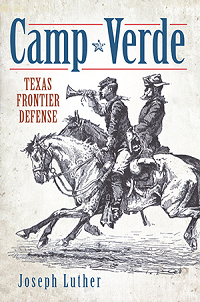 Author: Joseph Luther
Publisher: The History Press
Retail: $21.99
ISBN: 978-1609493868
Copyright: February 2012
Pages: 128
The Verde Valley the seemingly easy route to West Texas was in fact a land of peril, adventure, and near mythic heroes. Historic Camp Verde has long been a strategic stronghold guarding the pass, the valley and the many trails converging at this river crossing. As frontiersman and settlers pushed through the pass and Native Americans responded with violent force, the famed Texas Rangers attempted to control the region. Officially established in 1856, the camp would become the testing ground for the Army's Camel Experiment and an outpost for Robert E. Lee's legendary Second U.S. Cavalry. Join local historian Joseph Luther as he narrates the tumultuous and uniquely Texan history of Camp Verde.
Books by the Author:
- Details
- Written by Super User
CAMPBELL, KILLIS (1872–1937). Killis Campbell, writer and professor of literature, the son of Robert Camm and Alice (Hawes) Campbell, was born in Enfield, Virginia, on June 11, 1872. He earned a B.Litt. degree at Peabody College for Teachers in 1892 and a B.A. degree at William and Mary College in 1894. For graduate study in English he went to Johns Hopkins University, where he held a fellowship in 1897–98 and received his Ph.D. in 1898. The summers of 1897, 1902, and 1904 he spent studying in the British Museum and the Bodleian Library.
In 1899 he taught English at Culver Military Academy in Indiana. He then accepted an instructorship in English at the University of Texas, where he was made professor in 1918. He continued to teach until 1937, when he suffered a stroke from which he never fully recovered. Campbell's first scholarly love was the literature of the Middle Ages, and his definitive edition of a version of The Seven Sages of Rome (1907) was judged a model of scholarship. In the classroom he was subsequently drawn to the study of American literature, especially to Edgar Allan Poe. As a pioneer in the serious teaching of American literature, he was probably more influential than any other individual in the formation, about 1921, of the American Literature Study Group of the Modern Language Association of America. He was research professor at the University of Texas for 1930–31 and vice president of the MLA in 1934–35. In addition to editing The Poems of Edgar Allan Poe (1917) and Poe's Short Stories (1927), he published a number of essays on Poe under the title The Mind of Poe and Other Studies. In numerous shorter articles on Walt Whitman and James Russell Lowell as well as Poe, and in similar published works that he inspired his students to undertake and push to completion, Campbell made large contributions to knowledge. He died on August 8, 1937, and was buried in Austin. He was survived by his widow, Mary Hogg (Aitken), whom he had married in 1902, and five children. Campbell was a Democrat and a member of the Christian Church.
BIBLIOGRAPHY:
Carl John Eckhardt, One Hundred Faithful to the University of Texas at Austin (197-?). Vertical Files, Dolph Briscoe Center for American History, University of Texas at Austin. Who Was Who in America, 1943.
Robert Adger Law
Citation
The following, adapted from the Chicago Manual of Style, 15th edition, is the preferred citation for this article.
William E. Bard, "ADAMS, WALTER R.," Handbook of Texas Online (http://www.tshaonline.org/handbook/online/articles/fad08), accessed March 19, 2015. Uploaded on June 9, 2010. Published by the Texas State Historical Association.