Search
BlogRead the Latest News
Texas Authors Institute of History
A Unique Museum that saves history, inspires the future, depth and gives to the present..

- Details
- Written by Super User
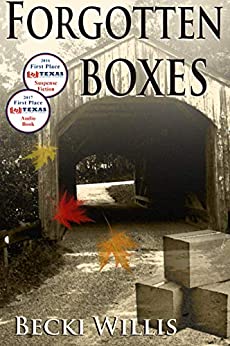
Named sole heir to her aunt's estate, Charity Gannon arrives in the Northeast Kingdom of Vermont, hoping to find a link to her past. She's not looking for lost treasures; she is searching for a connection to the aunt she barely knew.
What she finds is a thirty-something-year-old mystery and questions with no answers. A sad, secluded cottage, all but hidden amid the vines. A man's suit of clothes, tainted with dried blood and a bullet hole. Four forgotten boxes, stuffed into a large bag and buried in the far corners of the shed.
These are not just any boxes. These are unopened, undelivered boxes, left behind by the now-defunct Kingdom Parcel. All four boxes are marked March 14, 1984... the very day her uncle, president and driver for the delivery service, was said to have committed suicide. Four forgotten boxes, whose owners might still be out there, waiting for a delivery that never arrived.
The undelivered boxes haunt Charity, tugging at her conscience. Hadn’t someone noticed them missing? Hadn’t anyone wondered about the failed delivery? Thinking it might be fun to surprise the recipients after all these years, Charity sets out to deliver the packages to their rightful owners.
The story behind one box is delightful. Another is heartbreaking.
And one might very well be the death of her.
Named Best Suspense Fiction 2016 and Best Audio Book 2017 by the Association of Texas Authors.
Product details
- ASIN : B019D1GOU6
- Publisher : Clear Creek Publishers (December 13, 2015)
- Publication date : December 13, 2015
- Language : English
- File size : 4724 KB
- Text-to-Speech : Enabled
- Screen Reader : Supported
- Enhanced typesetting : Enabled
- X-Ray : Enabled
- Word Wise : Enabled
- Sticky notes : On Kindle Scribe
- Print length : 224 pages
- Details
- Written by Super User
Coppedge, Clay
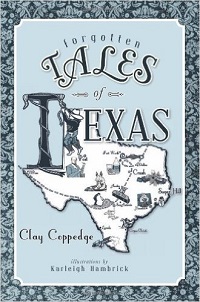 Author: Clay Coppedge
Publisher: The History Press
Retail: $16.99
ISBN: 978-1609492687
Copyright: May 2011
Pages: 128
From El Chupacabra to the Marx Brothers, Clay Coppedge has a talent for digging into Texas's most unusual history. Strange as they may seem, many of these Texas-sized legends are surprisingly true, like Pancho Villa's film contract and the notorious Crash at Crush, a staged train collision and failed publicity stunt that turned tragic outside of Katy. Whether fact or lore, each tale is irrefutably part of a unique and fascinating heritage that invigorates the spirit like a Texas frontier remedy.
Book by the Author:

- Details
- Written by Super User
FORMBY, MARSHALL CLINTON, JR. (1911–1984). Marshall Clinton Formby, Jr., public official and writer, was born on April 12, 1911, near Como, Hopkins County, Texas, the son of Marshall Clinton and Rosa Mae Formby. When he was five years old his family moved to McAdoo in Dickens County. There he attended public school through the junior year in high school. He obtained his diploma at Spur High School in 1928 and he enrolled in Texas Technological College (now Texas Tech University), where he received the bachelor of arts degree in 1932. He received his master's degree in journalism from the University of Texas in 1937.
His long career in public service began in 1936, when he was elected county judge of Dickens County, a position he held until 1940. He was elected to the Texas Senate and represented District Thirty (Lubbock) for a four-year term, although service in the United States Army (1942–46) precluded constant participation in Austin matters during World War II. On September 8, 1946, he married Sharleen Wells in Seale, Alabama. They had two children.
In 1948 Formby moved to Plainview, where he sold the Plainview Tribune, a weekly newspaper that he had purchased in 1941, and began to devote his time to the operation of a number of West Texas radio stations. His nephew, Clint Formby, served as manager and partner. After a year of study at the Baylor University School of Law, Formby was admitted to the state bar on December 4, 1952. He returned to Plainview, where, in 1953, he joined the law firm of a long-time friend, Judge Harold LaFont. In 1953 Governor Allan Shivers appointed him to the Texas Highway Commission, and he served as chairman of that body during the last two years (1957–59) of his tenure. The period of his membership on the commission was marked by an acceleration in the farm-to-market paved road program and by the construction of the Texas Turnpike, the tollway between Dallas and Fort Worth.
In 1962 Formby made an unsuccessful bid to be the Democratic nominee for governor of Texas. That same year saw the publication of his historical novel, These Are My People. He pursued his favorite hobby, travel, with vigor. In 1955 he visited Russia with a group of newspaper and radio editors. In 1960 he traveled to South and Central America and in 1968 took his family around the world. He went to China in 1979. Formby was named to the board of directors of Texas Tech University in 1967; he served in that capacity until 1971 when he was appointed to the Coordinating Board, Texas College and University System, (now the Texas Higher Education Coordinating Baordqv), a position he held for two six-year terms.
After a lengthy illness, probably from uremic poisoning, Formby died on December 27, 1984, at his home in Plainview. His funeral was held at the First Baptist Church there, and he was buried at McAdoo.
BIBLIOGRAPHY:
Austin American-Statesman, December 28, 1984. Dickens County Historical Commission, Dickens County: Its Land and Its People (Lubbock: Craftsman Printers, 1986). Vera D. Wofford, ed., Hale County Facts and Folklore (Lubbock, 1978).
William M. Pearce
Citation
The following, adapted from the Chicago Manual of Style, 15th edition, is the preferred citation for this article.
William E. Bard, "ADAMS, WALTER R.," Handbook of Texas Online (http://www.tshaonline.org/handbook/online/articles/fad08), accessed March 19, 2015. Uploaded on June 9, 2010. Published by the Texas State Historical Association.
- Details
- Written by Super User
Haenn, William F
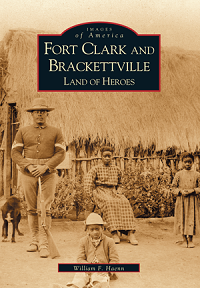 Author: William F Haenn
Publisher: Arcadia Publishing
Retail: $21.99
ISBN: 978-0738520636
Copyright: September 2002
Pages: 128
The story of Fort Clark and Brackettville began with a quiet pool of water, Las Moras Spring, named by the Spanish conquistadors for the mulberry trees lining its banks. The discovery of gold in California and the Treaty of Guadalupe Hidalgo precipitated the opening of the Lower Road from San Antonio to El Paso. To protect the spring and the travelers on the road, the U.S. government established a fort on the high ground above the spring. The town of Brackettville grew with the fort, and the area soon played host to an honor roll of American heroes. Revealed in some 200 images, many never before published, are some of the fort's most famous alumni, including Stuart, Longstreet, Sheridan, Sherman, Bullis, Patton, and Wainwright, in addition to the little-known Medal of Honor recipients buried there. Captured here are the deeds of a legion of unsung heroes, as well as the fort and town's historic past, highlighting the Indian War era, the Seminole Scouts, and the quiet time between the World Wars. Culled from the collections of the Library of Congress, the National Archives of the U.S. Army Signal Corps, and pioneer photographer Eugene O. Goldbeck, this book is a testament to American soldiers throughout the country.