Search
BlogRead the Latest News
Texas Authors Institute of History
A Unique Museum that saves history, inspires the future, depth and gives to the present..

- Details
- Written by Super User
Flowers and Stone

by Jan Sikes
RiJan Publishing
316 Pages
ISBN: 9780990617907
(c) 2014
First Edition - The TAIH Museum has one copy signed by the author.
A passionate love story set in the rowdy raucous honky-tonks of Texas in 1970. Nothing could have prepared Darlina Flowers for the reckless Texas rogue musician, Luke Stone, to come stampeding into her life like a team of wild horses. Their love ignited into an ever burning flame only to be split apart by fate and circumstance and separated by walls and bars. Luke Stone is arrested and falsely convicted of a crime he did not commit. A compelling true story that will capture your heart.
Personal History of the Book:
This is a Biographical Fiction book, meaning it is a true story but told through fictitious characters. It is a very personal story as I am one of the characters. Because of the time period of the story and Luke Stone's involvement in Texas music, there is a good bit of Texas music history woven throughout the book.
Other Books by the Author
Citation
Above was provided by Jan Sikes
- Details
- Written by Super User
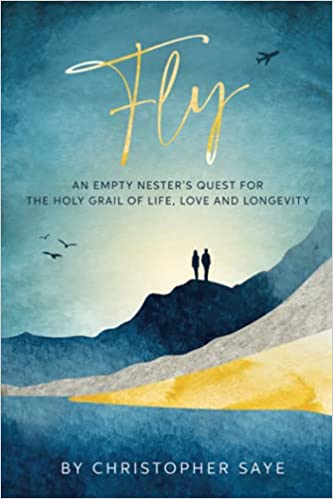
Upon becoming ‘empty nesters’ Chris and his wife of over 20 years decide to do something radical to shake up their lives and marriage. Raising three children had been the glue that held them together so far, but what would be next? They will spend a year traveling to the Blue Zones. These hotspots of longevity, identified by National Geographic explorer Dan Buettner, have a scientifically proven higher-than-average concentration of people living to 100 or more. Could these places hold a key to unlocking longevity not only in life but also in their now potentially fragile relationship?
Fly is Chris’s very personal story of his travels from Singapore to Okinawa, Costa Rica, Sardinia and the island of Ikaria in Greece (and beyond) to experience life with centenarians, intertwined with a search for hope and confidence to enter the next stage of life. Reflecting on the values he witnessed along the way helped him dig deep to rediscover his own core values, those which will guide him to live a life of purpose and meaning beyond the financial “success” he had sought and achieved so far in his dynamic, international professional career.
The British-American author is a financial advisor and coach who splits his time between Europe and Asia.
Product details
- Publisher : Christopher D. Saye (July 27, 2021)
- Language : English
- Paperback : 188 pages
- ISBN-10 : 1737645610
- ISBN-13 : 978-1737645610
- Details
- Written by Super User
FOOTE, HORTON, JR. (1916–2009). Horton Foote, Jr., distinguished Texas dramatist, was born Albert Horton Foote, Jr., on March 14, 1916, in Wharton, Texas. Horton Foote was the son of Albert Horton Foote and Harriet Gautier Brooks Foote and a descendent of the first lieutenant governor of Texas, Albert Horton. He grew up in Wharton with his two brothers Tom Brooks and John Speed. Foote finished high school at age sixteen, then lived a year in Dallas with his grandmother while working as an usher at the Majestic Theater and taking elocution lessons. Foote had dreams of being an actor, so he moved to California and enrolled in acting school at Pasadena Playhouse in 1933.
After completing acting school, Foote lived in New York City as a struggling thespian while taking acting classes from Tamara Daykarhanova, Andrius Jilinsky, Maria Ouspenskaya, and Vera Soloviova. Jilinsky, Soloviova, and Daykarhanova had studied with Constantin Stanislavsky and taught his “system” called “method acting.” Foote’s classmate Mary Hunter Wolf formed the American Actors Company to promote American talent in the theater and he joined in 1939. He began writing plays, the first of which was a one-act entitled Wharton Dance. His first three-act play was Texas Town. Only the Heart was Foote’s first play on Broadway at the Bijou Theatre in 1944. While working at Doubleday Book Store in Penn Station, he fell in love with Lillian Vallish and they married in 1945. After the American Actors Company disbanded in 1945, Foote became disappointed by the commercialism in post-World War II New York theater, so he and Lillian moved to Washington, D.C., and together they managed the acting school and theater productions at King-Smith School for the next four years. Foote returned to New York City in 1949 and was hired as a television writer for the children’s program The Quaker Oats Show, which debuted October 15, 1950. After fifty-four episodes, Foote focused on writing television plays. The Trip to Bountiful aired in 1953 on Goodyear Television Playhouse and was so well-received that it moved to Broadway and has been the most produced play of Horton Foote’s work. Twenty-four television plays written by Horton Foote aired between 1951 and 1964.
In 1955 Foote moved to Nyack, New York, and began raising a family with Lillian. Although he was brought up in the Methodist Church, he and Lillian converted to Christian Science shortly after his mother and sister converted in Texas. That same year Foote’s first screenwriting credit was the Cornel Wilde film, Storm Fear. The Chase, Foote’s only novel, was published in 1956 and was based on an earlier play. In 1961 Alan Pakula asked Foote to write the screenplay for Harper Lee’s novel, To Kill a Mockingbird. The film was released a year later, and Foote won an Oscar for the screenplay. Baby the Rain Must Fall, starring Steve McQueen and Lee Remick, premiered in 1965 and was filmed entirely in Columbia and Wharton, Texas. In the mid-1960s, Foote moved to New Boston, New Hampshire. He continued to write for Hollywood. His screenplay Tomorrow, based on a short story by William Faulkner, premiered to critical acclaim in 1972 and starred Robert Duvall. Next, Foote wrote the book for the musical adaptation of Gone With the Wind, which was produced in Los Angeles, London, and Dallas from 1973 to 1976.
After Foote’s parents passed away in the mid-1970s, he gathered all the family papers from Wharton and poured over them in his New Hampshire home. The various stories and conflicts of his family inspired him to write The Orphans’ Home Cycle, a collection of nine plays about three families in fictional Harrison, Texas. The plays in chronological order are Roots in a Parched Ground (1902); Convicts (1904); Lily Dale (1910); The Widow Claire (1912); Courtship (1915); Valentine’s Day (1917); 1918 (1918); Cousins (1925); and The Death of Papa (1928). HB Playhouse began producing the The Orphans’ Home Cycle plays in the late 1970s, and Foote moved back to New York City. HB Playhouse did not pay for plays, so Foote supported himself by writing for television again. Titles included Flannery O’Connor’s The Displaced Person; William Faulkner’s Barn Burning; and Keeping On. Foote continued to write and direct for the theater, but he also continued to make films. During the 1980s, Foote lived in his childhood Wharton home and filmed three of the The Orphans’ Home Cycle works (1918, Courtship, and Valentine’s Day), as well as The Trip to Bountiful, Tender Mercies, and The Habitation of Dragons in Texas. Convicts, the second work in The Orphans’ Home Cycle, was released as a film in 1990 and Foote’s screen adaptation of John Steinbeck’s Of Mice and Men was released in 1992. After his wife Lillian passed away in 1992, Foote lived with his daughter Hallie, and her husband in Pacific Palisades, California.
Foote continued to write for theater, television, and film for almost two decades while receiving critical acclaim for his body of work. Most notable are the Pulitzer Prize-winning play The Young Man From Atlanta(1995) and the Emmy-winning Old Man, based on a story by William Faulkner. In early 2009, Horton stayed in Hartford, Connecticut, with his daughter Hallie and her husband, Devon Abner, while he worked on completing the scripts for The Orphans’ Home Cycle for the Hartford Stage Company. Horton Foote passed away in his sleep on March 4, 2009 at the age of ninety-two. Unfortunately, he did not get to see his last two works completed. The Orphans’ Home Cycle was staged in its entirety at Hartford Stage Company in the 2009–10 season and moved to Signature Theater in New York in 2010. Foote’s screenplay for Main Street, a film starring Colin Firth and Orlando Bloom, was completed in 2010 and released in the fall of 2011.
Frank Rich, the New York Times chief theater critic in the 1980s, described Foote as “a major American dramatist whose epic body of work recalls Chekhov in its quotidian comedy and heartbreak and Faulkner in its ability to make his own corner of America stand for the whole.” Foote’s theatrical honors include a Pulitzer Prize for The Young Man From Atlanta (1995); Lucille Lortel Awards for The Orphans Home Cycle (2010) and The Trip to Bountiful (2006); and an OBIE award for Dividing the Estate (2008). His screenwriting honors include Oscars for To Kill a Mockingbird (1962) and Tender Mercies (1983); an Emmy for Old Man (1997); an Independent Spirit Award for The Trip to Bountiful (1986); and the Writers Guild of America awards for To Kill a Mockingbird (1963) and Tender Mercies (1984). Foote was also a member of the Theatre Hall of Fame, the American Academy of Arts and Letters, the Fellowship of Southern Writers, and a recipient of the National Medal of Arts in 2000 by President Bill Clinton.
Horton and Lillian Foote had four children: Barbara Hallie, Albert Horton Foote III, Walter, and Daisy. In 1992, DeGolyer Library at Southern Methodist University acquired Horton Foote’s extensive personal papers. The library held an exhibition on Foote’s career during the 2011 Horton Foote Festival in Dallas, Texas, which presented seventeen works by Horton Foote.
BIBLIOGRAPHY:
Horton Foote Papers, DeGolyer Library, Southern Methodist University, Dallas. “Horton Foote,” Ronald L. Davis Oral History Collection, DeGolyer Library, Southern Methodist University, Dallas. Horton Foote,Beginnings: A Memoir (New York: Scribner, 2001). Horton Foote, Farewell: A Memoir of a Texas Childhood (New York: Scribner, 1999). Horton Foote, Genesis of an American Playwright , Marion Castleberry, ed. (Waco: Baylor University Press, 2004). Wilborn.Hampton, Horton Foote: America’s Storyteller (New York: Free Press, 2009). Laurin Porter, Orphans’ Home: The Voice and Vision of Horton Foote (Baton Rouge: Louisiana State University Press, 2003). Charles S. Watson, Horton Foote: A Literary Biography (Austin: University of Texas Press, 2003). Gerald C. Wood, Horton Foote and the Theater of Intimacy (Baton Rouge: Louisiana State University Press, 1999).
Cynthia Franco
Citation
The following, adapted from the Chicago Manual of Style, 15th edition, is the preferred citation for this article.
William E. Bard, "ADAMS, WALTER R.," Handbook of Texas Online (http://www.tshaonline.org/handbook/online/articles/fad08), accessed March 19, 2015. Uploaded on June 9, 2010. Published by the Texas State Historical Association.
- Details
- Written by Super User
For a Fish to Soar
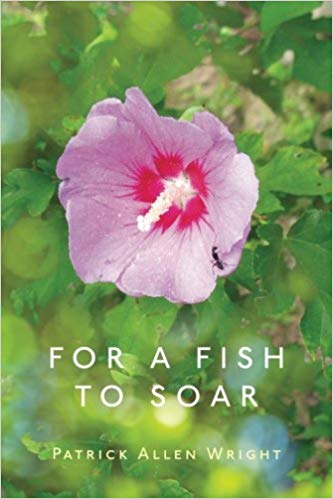
Author: Patrick Allen Wright
ISBN: 978-1546812630
Price: $15.00
For a Fish to Soar is a book of 100 poems arranged into five (5) sections with an Afterword. It has the standard Acknowledgments, a dedication page, and the Contents. The sections of poems are: I. Knowing So Much of the Earth; II. That Nature Will Provide; III. And Wants Her by His Side; IV. Necessary for a Fish to Soar; and V. I Pray for Rain, Yet Still. I. Knowing So Much of the Earth includes seventeen (17) poems, focusing mostly on natural settings at beaches, ponds, rivers, and streams. The poems establish a spiritual leaning toward ecological concerns. The poems range in length from several pages to haiku and couplet. II. That Nature Will Provide includes twenty-one (21) poems, focusing on more pastoral settings. A spiritual, zen-ish theme continues from the first section and builds appreciation for nature. The poems range in length from haiku and couplet up to a full page or two. III. And Wants Her by His Side contains eighteen (18) poems, incorporating nature, aging, love, and love lost. The pastoral settings sometimes become a classroom for living and coping. Here, the poem lengths vary from couplet and haiku length to a full page. IV. Necessary for a Fish to Soar presents twenty-three (23) poems, including the titular poem "Dauntless." The poems address poetics and the somewhat spiritual origins and inspirations for poems. The zen-ish or Taoist emphases become clearer, as do the more Western ideas of God and gods. Some poems express societal elements. The poems range in length from couplet and haiku to a couple of pages. V. I Pray for Rain, Yet Still brings in twenty-one (21) poems of darker tidings, such as abuse, death, indiscretions, illness, and other issues of humanity. Rural settings dominate, but a few poems address the effects of Vietnam Era service and homecoming. However, this section, and thus the collection of poems, ends with a more upbeat note. The poems range from several pages to haiku length. The Afterword comprises five pages of discussing poetics: "Poetic Signature" gives some insight for the development of writer's voice and reader's response. "Empathy" helps to clarify the relationship between readers, writers, and poems. "The Poet's Chore" briefly touches on a writer's preparation, purpose, and the writing process. "Maker Making" culminates the discussion of poetics with a few words melding the genesis of poems culturally, touching on some Asian ideas for poets and poems.