Search
BlogRead the Latest News
Texas Authors Institute of History
A Unique Museum that saves history, inspires the future, depth and gives to the present..

- Details
- Written by Super User
Es
 ISBN: 978-1507883341
Price: $14.95
Number of Pages: 254
Published by: CreateSpace Independent Publishing Platform
When Hugh Bancroft, Jr., family owner of The Wall Street Journal, died, he left his wife, Jackie Bancroft, one of the wealthiest women in America. After she built the Spencer Theater in Ruidoso, New Mexico, and paid twenty-three million in cash for it, she married her gay interior decorator, Ron Morgan, for the last fling of her life. Glen Aaron, author, was the lawyer for for Morgan and had been so for many years through multiple legal problems. As Aaron came to know Jackie, they became fast friends and she often used him as consigliore and to double check what her vast array of trust lawyers were telling her. On an extended world cruise, Jackie became suspiciously and seriously ill. It became Aaron's duty to retrieve her from the cruise trip in the middle of the southern Atlantic and get her to health care in the U.S., where she ultimately died. Her death precipitated numerous lawsuits from her heirs and Morgan, himself, who had manipulated a position of heirship. This five year intrigue ultimately led the author, Glen Aaron, to federal prison on a technicality, a path he would never have anticipated. That path evolved into The Prison Trilogy, and The Ronnie Lee and Jackie Bancroft Spencer Morgan Story is the beginning
History of the book:
We all have personal defects. As a lawyer, I did not sit in judgment. Were a lawyer to do that the lawyer would have no clients. You will be able to identify yourself somewhere in Jackie's story, bizarre as it may be. But what you will see is what your small defective seed would look like if it were to explode into the extreme. Folded within this story is the history of the Wall Street Journal from founder Charles Dow and his creation of the formula for judging the direction of the NYSE to being out-traded by Clarence Barron in acquiring the Journal to Hugh Bancroft inheriting the Journal and committing suicide over it in the Great Depression. This is a story that had to be told as the Bancroft reign came to an end with Rupert Murdoch paying the Bancroft's five dillion dollars for the Journal a century later.
Other books by the author:
- Details
- Written by Super User
Fowler, Gene
 Author: Gene Fowler and the Somervell County Historical Commission
Publisher: Arcadia Publishing
Retail: $21.99
ISBN: 978-0738519425
Copyright: February 2012
Pages: 128
Charles Barnard, a Connecticut entrepreneur, settled in the Brazos Valley in 1849, running an Indian Trading Post. He built a gristmill in 1860 near the confluence of the Brazos and Paluxy Rivers, around which the town of Glen Rose sprang up. Captured here in over 200 vintage photographs and postcards is the history of this quintessential little Texas town, from its origins as a mill town, to the bedroom community of Fort Worth that it has become today. In its earliest days, settlers flocked to the region from the war-torn South during the Civil War. By the 1900s, both Somervell County and Glen Rose established fame as a tourist resort, offering springs and artesian waters to heal the body and spirit. Naturopathic and magnetic healers built sanitariums, while locals built tourist parks to entertain the crowds that came for rest and relaxation. Showcased here are images of the Hill postcard collection, which relay the intriguing story of Glen Rose as a recreation mecca, the Moonshine Capital of Texas during Prohibition, the discovery of the infamous dinosaur tracks, and its development as it enters the 21st century.
- Details
- Written by Super User
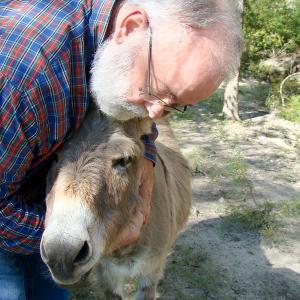
My books are time capsules that combine artwork, prose and poetry, or graphics to show in common patterns of experience in our lives. Every person has a chaotic sequence of experiences creating their life collage that in literature might be described as a narrative or life story. In many of our own lives these experiences remain fragmented. Then, we have trouble identifying our own narrative. My time collages are intended to represent that chaotic chain of experiences and offer other opportunities for the reader to process images and language elements of generalized patterns. I hope these relationships may be useful in the reader's personal lives.
When I graduated from high school in 1965 I worked in graphics for an aircraft company contracted to NASA. I helped make long Mylar PERT charts which covered rows of tables. One day the boss called us to a table to show us photographs. I was in awe. There on the table was a Hasselblad color photo of Astronaut Edward White; the first American had just floated in space. A new and fresh blue earth revolved behind him. This photo was later published as a cover on Life Magazine. It changed my perspective of everything. Visual images and language together help create our perspective and create a providence, or map, which helps us create our personal fate. For fifty years I combined artwork and technical illustration with written content to explain processes for preschool, public school, university, and health professionals. All of my books, or sequential collages, express the transparency within life's process.