Search
BlogRead the Latest News
Texas Authors Institute of History
A Unique Museum that saves history, inspires the future, depth and gives to the present..

- Details
- Written by Super User
GONZÁLEZ AMEZCUA, CONSUELO (1903–1975). Consuelo (Chelo) González Amezcua, artist and poet, was born in Piedras Negras, Mexico, on June 13, 1903, the third of six children born to Jesús González Galván and Julia Amezcua Saenz. In 1913 her family immigrated to Del Rio, Texas, where she spent the rest of her life. She attended school for six years and learned to read and write in English but received no formal art training. In the 1930s she was awarded a scholarship to attend San Carlos Academy in Mexico City but turned it down due to her father's death. She worked as a clerk in a local department store in Del Rio and dedicated her free time to her drawings and poetry. During the summers she traveled throughout Mexico for artistic inspiration.
González is best known for her "filigree art": complex illustrations reminiscent of the intricate metal work found in Mexican jewelry. Beginning in 1956 she carved shell stone from the banks of the Pecos River into elaborate designs. Eight years later she abandoned the arduous carving medium in favor of intricate drawings made with ballpoint pens on paper or cardboard. Initially she used black ink on a white ground, occasionally adding red, blue, and green inks. During the last five years of her life she added crayons and felt-tip pens to her repertoire and introduced many more colors into her designs.
Her subjects are elaborately drawn, composed of tiny lines within curving patterns. They reveal her fascination with dreams and myths, as well as the dramatis personae of pre-Columbian history: gods, muses, and such royal personages as Cleopatra, the Náhuatl poet, and King Netzalhualcóyotl. Birds, flowers, fanciful architecture, starry skies, hands, and beautiful women were her favorite motifs, either as subjects, or backgrounds for works with historical or philosophical themes. González honored her Mexican-American heritage in works such as Mexico Americans (1969), in which a hand holds a banner representing North and South America, united by a design radiating from a medallion inscribed "Mexico Americans." She placed an eagle, the national symbol for Mexico and the United States, over the map, and beneath the banner wrote "Soy Americana de descendencia Mexicana/ y por doquiera que voy se llevar con dignidad/ el nombre de los Estados Unidos y Mexico" ("I am an American of Mexican descent/ and wherever I go I take with me the dignity/ of the United States and Mexico").
González often incorporated her poetry into the drawings, and wrote personal thoughts or explanations on the back of each piece. She also compiled a book of her verse titled Cantares y Poemas. Her poems focused on themes such as her love of border culture, the lives of various friends and family members, her faith in religion and humanity, and the Chicano Movement. She won prizes for her poetry in Mexico but did not receive recognition for her drawings until 1968, when her work was featured in a solo exhibition at the Marion Koogler McNay Art Museum in San Antonio. She subsequently exhibited her work in Monterrey, Nuevo León (1968); the Hemisfair, San Antonio (1968); Springfield, Massachusetts (1969); the Wilson Memorial Art Center in Beaumont, Texas (1970); and Trinity University, San Antonio (1973). Chelo González Amezcua died on June 23, 1975. Her work has since been exhibited in the Bronx Museum of Art, New York (1988); several gallery exhibitions in New York City (1991); and the McNay Art Museum, San Antonio (1991). In 1991 the Del Rio Council for the Arts organized an exhibition of her work that traveled to various Texas museums in 1992 and 1993. Examples of her work may be found in the Whitehead Memorial Museum, Del Rio, and many private collections.
BIBLIOGRAPHY:
Consuelo Gonzales Amezcua Papers, Benson Latin American Collection, University of Texas at Austin. Jacinto Quirarte, "Image and Text in the Work of Consuelo González Amézcua," Research Center for the Arts Review 5 (January 1982). Jacinto Quirarte, Mexican American Artists (Austin: University of Texas Press, 1973). Jacinto Quirarte and Rolando Hinojosa-Smith, Mystical Elements/ Lyrical Imagery: Consuelo González Amezcua, 1903–1975 (Del Rio, Texas: Del Rio Council for the Arts, 1991). Manuel Chaca Ramírez Collection, Benson Latin American Collection, University of Texas at Austin. Ruthe Winegarten, Finder's Guide to the`Texas Women: A Celebration of History' Exhibit Archives (Denton: Texas Woman's University Library, 1984). Ruthe Winegarten, Texas Women (Austin: Eakin Press, 1985).
María-Cristina García
Citation
The following, adapted from the Chicago Manual of Style, 15th edition, is the preferred citation for this article.
William E. Bard, "ADAMS, WALTER R.," Handbook of Texas Online (http://www.tshaonline.org/handbook/online/articles/fad08), accessed March 19, 2015. Uploaded on June 9, 2010. Published by the Texas State Historical Association.
- Details
- Written by Super User
Kelton, Elmer
 Author: Elmer Kelton
Publisher: Doubleday; 1st edition
Retail: Varies
ISBN: 978-0385133159
Copyright: March 1978
Pages: 253
Editorial Reviews
“The Good Old Boys is probably the closest I have ever come to writing from sheer inspiration. Hewey Calloway and the other characters took hold of the story like a cold-jawed horse grabbing onto the bit, and about all I could do was hang on for the ride.” ―Elmer Kelton
“One of the best of a new breed of Western writers who have driven the genre into new territory.” ―The New York Times
Texas Tradition Series
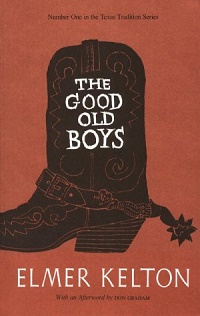 Author: Elmer Kelton
Publisher: Texas Christian University Press
Retail: Varies
ISBN: 978-0385133159
Copyright: January 1, 1985
Pages: 258
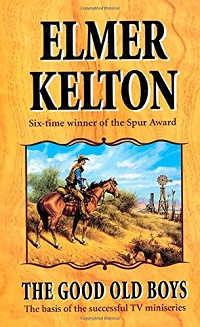 Author: Elmer Kelton
Publisher: Forge Books; 1st edition
Retail: Varies
ISBN: 978-0812575996
Copyright: April 15, 1999
Pages: 306
Barbed WireBitter Trail
Bowie's Mine
Day the Cowboys Quit, The
Far Canyon, The
Good Old Boys, The
Honor at Daybreak
Hot Iron
Joe Pepper
Living and Writing in West Texas
Man Who Rode Midnight, The
Many a River
Pecos Crossing
Shadow of a Star
Six Bits a Day (Hewey Calloway)
Slaughter
Time It Never Rained, The
Wolf and the Buffalo, The
- Details
- Written by Super User
GORDON, ROXY LEE [FIRST COYOTE BOY] (1945–2000) Roxy Lee Gordon (First Coyote Boy) was a Choctaw musician/songwriter, performance poet, author, multimedia artist, and American Indian activist whose work spanned the decades of the 1970s through the 1990s. Hailed as progressive country witness and legendary outlaw poet, Gordon’s style spanned the genres of contemporary folk and alternative country music. Born on March 7, 1945, in Ballinger, Texas, he was the only child of Robnette L. (Bob) and Louise (Bomar) Gordon. He was raised in rural West Texas in Coleman County on the outskirts of the town of Talpa near Abilene, where his grandfather played the harmonica at country dances and his mother played piano at the Methodist Church in Talpa. He received his first guitar, a Montgomery Ward Archtop F-hole, from a mail-order catalog when he was fourteen years old. The instrument was later stolen outside of Wimberley, Texas. Upon completion of high school, Gordon moved to Austin to study at the University of Texas, where he edited Riata, the student literary magazine. In 1964 he married Judy Nell Hoffman in Talpa.
The couple traveled to northern Montana by the late 1960s, where they lived in a one-room log cabin in Lodge Pole, Montana, and Gordon produced the Fort Belknap Notes, a weekly newsletter of the Assiniboine and Gros Ventre reservation. They moved on to San Diego, California, and he attended classes at the California Institute of Technology in Pasadena, California, where he met Jim Morrison (of The Doors) and avant-garde writer Richard Brautigan, who introduced him to fellow writers Robert Creely, Ed Dorn, Clayton Eshleman, and Michael McClure. Gordon visited with this writing circle in Long Beach, California, before traveling back to Austin.
By the early 1970s Gordon had settled in the town of Moriarty outside Albuquerque, New Mexico, where he and his wife published the music magazine, Picking up the Tempo. The Gordons moved to Dallas in 1976, where they founded and operated the small publishing company, Wowapi Press, and Gordon wrote for the Coleman Chronicle and Democrat Voice newspaper. He lived in East Dallas until his father’s death in 1997, when he moved back to Talpa to help care for his ailing mother and ninety-seven-year-old grandmother.
A versatile performer on guitar, drums, and vocals, Gordon played with numerous bands and shared the stage and studio with such notable musicians as Bob Dylan,Ernest Tubb, Leonard Cohen, and Townes Van Zandt. Performance poetry with music peaked during the 1980s, and Austin was hailed as the locus of the Texas “third coast” music scene. Recognized as one of the best original Austin performance poets, Gordon went on to national and international notoriety. Part of the notoriety stemmed from his involvement in the American Indian Movement (AIM). He was instrumental in establishing a local chapter in Dallas, which had a population of more than 12,000 Native Americans in the early 1990s. The Dallas chapter of AIM was officially recognized at the Tribunal held in November 1994 in Rapid City, South Dakota.
For twenty years, the Gordon home in East Dallas was a veritable mecca for artists, writers, and activists. The house itself was an eclectic artscape with animal bone sculptures hanging down on the front porch, including steer pelvises, cow skulls, ribs, and femurs. Musician Jeff Liles recalled the time he walked into their living room to find legendary singer–songwriter Townes Van Zandt sitting off in the corner, singing his songs for a handful of people. At Van Zandt’s memorial concert in 1997, Gordon shared stories of their notorious escapades, including the time he smuggled the singer a bottle of vodka before Van Zandt was about to play a gig billed as the "Alcohol and Drug-Free Concert'' on an Indian reservation.
Gordon published six books and more than 200 poems, articles, and short fiction; he also coauthored two plays with Choctaw writer, LeAnne Howe. His work is used in several college Indian studies courses and in the creative writing program at Schreiner College in Kerrville, Texas. He often supplied supplementary information with his record albums, including a twenty-page chapbook for Townes Asked Did Hank Williams Ever Write Anything As Good As Nothing (2001) and a twenty-four-page chapbook with artwork for Crazy Horse Never Died (1989). His 1993 album, Kerrville Live, was a family affair, with Gordon on guitar and drum; his son Quanah Parker on fiddle and drum; and his wife Judy Gordon as producer. His 1997 album, Smaller Circles, was produced by fellow musician Wes McGhee.
Raised in the Methodist Church tradition, Gordon decided as a young adult to explore his Native spiritual roots. This search came to fruition in 1991 when he was adopted by the John and Minerva Allen family in a traditional ceremony at the Assiniboine Sundance at the Belknap Reservation in northern Montana. At this time, Gordon received his Assiniboine name,“Toe GaJukeJuke Gan Hok Sheena” which means “First Coyote Boy.”
Although Gordon wrote for the Democrat Voice newspaper for many years, his personal writings reflected his stated allegiance to the political goals of the American Indian Movement to promote Native identity and Native rights. In 1971 he received a literary award from the Southeastern Library Association’s Southern Books Competition for his autobiography, Some Things I Did (1971).
Roxy Gordon died in Abilene, Texas, on February 7, 2000, after a lengthy battle with cirrhosis of the liver. Judy Gordon, his lifetime partner and artistic colleague, continued to make her husband’s publications and recordings available online after his death. The couple had two sons, John Calvin Corrine Gordon of Dallas, and Quanah Parker Gordon of Talpa, who performed and recorded with his father. The Roxy Gordon Memorial was held on May 14, 2000, at the Sons of Hermann Hall in Dallas. Performers included Terry Allen, The Gourds, Richard Dobson, Pleasant Grove, Texanna Dames, Tommy Hancock, Jeff Liles, Robert Trammell, The Ackermans, Glen Alyn, and others. Proceeds from the admission charge went to the Leonard Peltier Defense Fund and to the establishment of the Roxy Gordon Fellowship for Songwriters.
BIBLIOGRAPHY:
Dallas Observer, February 26, 1998; May 11, 2000. Mimi Gisolfi D’Aponte, ed., Seventh Generation: An Anthology of Native American Plays (New York: Theatre Communications Group, Inc., 1999). Roxy Gordon: First Coyote Boy (http://www.roxygordon.com/), accessed May 12, 2011. Brian Wright-McLeod, The Encyclopedia of Native Music: More Than a Century of Recordings from Wax Cylinder to the Internet (Tucson: University of Arizona Press, 2005).
Paula J. Conlon
Citation
The following, adapted from the Chicago Manual of Style, 15th edition, is the preferred citation for this article.
William E. Bard, "ADAMS, WALTER R.," Handbook of Texas Online (http://www.tshaonline.org/handbook/online/articles/fad08), accessed March 19, 2015. Uploaded on June 9, 2010. Published by the Texas State Historical Association.
- Details
- Written by Super User
GOUGH, LYSIUS (1862–1940). Lysius Gough, farmer, businessman, and author, one of ten children of Asher and Elizabeth Gough, was born in Lamar County, Texas, on July 29, 1862. His father, a minister in the First Christian Church, owned a 160-acre farm on which Gough developed an early interest in cattle raising. In 1876, at the age of fourteen, he ran away from home and got his first job as a cowboy for B. L. Murphy, who ran cattle in Hopkins and Hunt counties. During the next five years Gough participated in several overland drives to Kansas. In 1882 Jule Gunter hired him to work for the T Anchor Ranch. Because he never swore, Gough's fellow cowhands gave him the nickname "Parson." He remained with the T Anchor until 1884, when he decided to complete his education. He entered Pilot Point Institute, finished high school at the age of twenty-six, obtained a teaching certificate, and was hired to be principal of the institute. While he was there, Gough published his first collection of cowboy verse, Western Travels and Other Rhymes (1886).
He also studied law and qualified for the legal profession. In 1888 he married Ida Russell, a former pupil of his at Pilot Point, and they settled on a farm south of Dimmitt. They had ten children, six of whom lived to adulthood. In 1891 Gough taught the county's first school in Dimmitt. Later that year he assisted in the organization of the county and was elected the first county judge. In October 1898 the Goughs moved to Hereford, where he engaged in the real estate business and was for a time in partnership with C. G. Witherspoon. In 1910 Gough was involved with D. L. McDonald in the drilling of irrigation test wells and was among the first to drill his own irrigation well. In 1911 he entered into a contract with the C. B. Livestock Company of Crosby County and conducted experimental work on 10,000 acres to determine what crops and seed types would be most profitable in the county. His detailed weekly reports are in the archives of the Panhandle-Plains Historical Museum. After 1914 Gough began large-scale farming for himself. He was president of the Texas Wheat Growers Association from 1923 until 1928. In 1929 he published a book entitled Crime, in which he denounced the activities of speculators in the Grain Exchange and their effects on prices paid to farmers. He began lecturing on farm subjects and was known throughout the Great Depression as a champion of farmers' rights.
Gough was also among those who sought to preserve the Panhandle's frontier heritage. In 1922 he initiated the annual T Anchor Reunion and helped organize the Panhandle-Plains Historical Society. He supported the building of the Panhandle-Plains Historical Museum and secured several collections of historic interest for it. Known as the cowboys' "poet laureate," he published Spur Jingles and Saddle Songs in 1935. This work included many of the poems from his earlier book Western Travels. Gough was found dead at his home in Amarillo on the morning of November 2, 1940. In his typewriter was his last poem, prophetically titled "Gone."
BIBLIOGRAPHY:
Castro County Historical Commission, Castro County, 1891–1981 (Dallas: Taylor, 1981). Joseph A. Hill, The Panhandle-Plains Historical Society and Its Museum (Canyon, Texas: West Texas State College Press, 1955). C. Boone McClure, "Lysius Gough," Panhandle-Plains Historical Review 19 (1946).
- Allen Anderson
Citation
The following, adapted from the Chicago Manual of Style, 15th edition, is the preferred citation for this article.
William E. Bard, "ADAMS, WALTER R.," Handbook of Texas Online (http://www.tshaonline.org/handbook/online/articles/fad08), accessed March 19, 2015. Uploaded on June 9, 2010. Published by the Texas State Historical Association.