Search
BlogRead the Latest News
Texas Authors Institute of History
A Unique Museum that saves history, inspires the future, depth and gives to the present..

- Details
- Written by Super User

Leonie Waithman was born and raised in The Netherlands as the youngest of three girls. She attributed her passion for storytelling to her early years, when her father made up stories at bedtime. Leonie's first writing took place in elementary school, where she wrote in a diary every Monday morning that was sent home to the parents at the end of the semester. Her mother said that since Leonie was always playing outside, reading the vivid stories in her school diary of adventures that had taken place on the weekends with neighborhood kids was something she treasured.
After graduating from college, Leonie pursued her passion for traveling and met her British husband in Australia. She worked in England for several years before moving to Texas in 2001.
Leonie lives in Katy, Texas with her husband, her three children, a cat, and a German Shepherd who is never far from her sight.
When not writing, she is an avocational archaeologist, and volunteers her time at a state historic site educating students about the Texas Revolution.
She loves to ride horses, explore ancient ruins (she has a bucket list of ancient ruins and historic sites yet to visit), swim, hike, and spend time with family and friends.
- Details
- Written by Super User
Leslie Tourish was an English major, who became a photojournalist, then a psychotherapist, and has come back full circle to what she’s always loved - writing. Her debut fiction novel, The Headshrinker’s Brigade, was published in 2018 by Treaty Oak Publishers. This book tells the story of Julia Longley, a young woman who trades one crazy world for another against the backdrop of working in a small mental health clinic in the Texas hill country. Who is more challenging to Julia, the clients or the staff?
She’s currently working on her second novel about the complex world of twin sisters who are at cross purposes while being pursued by the kind of guy you definitely don’t want to meet alone in a dark alley.
- Details
- Written by Super User
Author Sandra Fox Murphy
Let the Little Birds Sin

Synopsis
In 1847, the McCord family, filled with hope for prospects of a better life, packed all their earthly belongings into covered wagons and left their homes in Indiana for Texas. The world beyond was in front of seven-year-old Fidelia, and little did she know, as the wagons traveled down the dusty trail to the southwest, that there would be the need for all the courage she could muster. Her faith would be tested and fortitude found in the most unexpected places.
Let the Little Birds Sing is the beginning of Fidelia McCord's story, of the hardships she encounters and sees around her, told through the eyes of a precocious and determined girl. It is a tale set in early America inspired by the journey of a girl coming of age amidst the perils of settling in a new and untamed land.
- Details
- Written by Super User
Prefaced by a biographical sketch, this volume presents a collection of Bedichek letters that give us an insight into his literary and creative development.
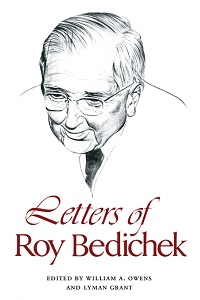 Although Roy Bedichek published less than his more famous friends J. Frank Dobie and Walter Prescott Webb, he wrote voluminously and, many say, with more distinction than the others. In addition to his four published books, Bedichek produced a great number of letters through which he communicated his broad interests and deep learning to a wide variety of correspondents.
Prefaced by a biographical sketch, this volume presents a collection of Bedichek letters that give us an insight into his literary and creative development—from his earliest years through his career at the University of Texas and on into his later years. They include letters to his closest associates, J. Frank Dobie and Walter Prescott Webb, and to many old friends, such as William A. Owens, John A. Lomax, and John Henry Faulk. Also included is Bedichek's correspondence with other contemporaries, not all old friends, among them Texas Governor James Ferguson, the recipient of some of Bedichek's most trenchant criticism. Throughout this collection, Bedichek's sparkling wit and profound learning are evident as he discusses his favorite subjects, among them ecology, education, literature, politics, and history, frequently related to Texas.
When Roy Bedichek gave his collection of letters to the Barker Collection in the University of Texas Library, he designated William A. Owens as the authorized editor of the letters, with the restriction that none of them be published until seven years following his death, which came in 1959.