Search
BlogRead the Latest News
Texas Authors Institute of History
A Unique Museum that saves history, inspires the future, depth and gives to the present..

- Details
- Written by Super User
Kelton, Elmer
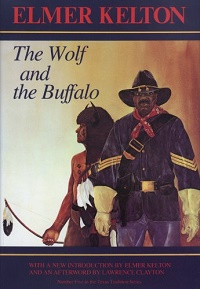 Author: Elmer Kelton
Publisher: Texas Christian University Press; Fourth Printing edition
Retail: Varies
ISBN: 978-0875650593
Copyright: February 1, 1986
Pages: 420
From the author of "The Far Canyon" and "The Good Old Boys" comes this poignant story of a freed slave who goes west with the army and confronts much more than the hostilities of the Comanche and Kiowa.The Civil War has ended and Gideon Ledbetter is feed from slavery. Like many, he has no land, no money, and no means to make a living. Gideon is drawn into the army by a recruiter who paints an alluring picture of cavalry life out in the west. The Indians called the black men "Buffalo" soldiers, as their tightly twisted hair reminded them of the large animals that they hunted for survival. Gideon is drawn into a conflict with a Comanche warrior, Gray Horse Running, which leads to a shattering confrontation on the plains of west Texas. This is the story of two men drawn together amid the blood and the fury of a conflict not of their making.
Editorial Reviews
From the Publisher
From the author of The Far Canyon and The Good Old Boys comes this poignant story of a freed slave who goes west with the army and confronts much more than the hostilities of the Comanche and Kiowa.
The Civil War has ended and Gideon Ledbetter is feed from slavery. Like many, he has no land, no money, and no means to make a living. Gideon is drawn into the army by a recruiter who paints an alluring picture of cavalry life out in the west. The Indians called the black men "Buffalo" soldiers, as their tightly twisted hair reminded them of the large animals that they hunted for survival. Gideon is drawn into a conflict with a Comanche warrior, Gray Horse Running, which leads to a shattering confrontation on the plains of west Texas. This is the story of two men drawn together amid the blood and the fury of a conflict not of their making. --This text refers to an out of print or unavailable edition of this title.
From the Inside Flap
From the author of The Far Canyon and The Good Old Boys comes this poignant story of a freed slave who goes west with the army and confronts much more than the hostilities of the Comanche and Kiowa.
The Civil War has ended and Gideon Ledbetter is feed from slavery. Like many, he has no land, no money, and no means to make a living. Gideon is drawn into the army by a recruiter who paints an alluring picture of cavalry life out in the west. The Indians called the black men "Buffalo" soldiers, as their tightly twisted hair reminded them of the large animals that they hunted for survival. Gideon is drawn into a conflict with a Comanche warrior, Gray Horse Running, which leads to a shattering confrontation on the plains of west Texas. This is the story of two men drawn together amid the blood and the fury of a conflict not of their making. --This text refers to an out of print or unavailable edition of this title.
 Author: Elmer Kelton
Publisher: Doubleday; 1st edition
Retail: Varies
ISBN: 978-0385144254
Copyright: August 1980
Pages: 398
 Author: Elmer Kelton
Publisher: Bantam Books; First Thus edition
Retail: Varies
ISBN: 978-0553226591
Copyright: 1980
Pages: 398
Other Books by the Author
Barbed WireBitter Trail
Bowie's Mine
Day the Cowboys Quit, The
Far Canyon, The
Good Old Boys, The
Honor at Daybreak
Hot Iron
Joe Pepper
Living and Writing in West Texas
Man Who Rode Midnight, The
Many a River
Pecos Crossing
Shadow of a Star
Six Bits a Day (Hewey Calloway)
Slaughter
Time It Never Rained, The
Wolf and the Buffalo, The
- Details
- Written by Super User
WOOD, WILLIAM DANIEL (1828–1906). William Daniel Wood, lawyer, judge, Confederate officer, state senator and representative, was born in Edgecombe County, North Carolina, on March 11, 1828. He was the son of Isaac F. and Peninah (Horn) Wood. Wood was raised in Randolph County, Indiana, and, prior to leaving that state for Alabama in 1850, received a license to practice law from the Indiana Supreme Court. In Choctaw County, Alabama, Wood worked briefly as a school teacher. On November 14, 1851, he immigrated to Texas and settled in Centerville in Leon County. Wood and his brother established the region’s first newspaper, the Leon Pioneer, which ran from 1852 to 1856.
Wood was also active in politics and community affairs and joined the Masons and Odd Fellows. He worked as a lawyer and judge and won election as a state representative for Leon County in the Seventh Texas Legislature. He served from November 2, 1857, to November 7, 1859. In 1860 Wood married Jane S. Lamberth in Leon County. This couple had no children.
At the outbreak of the Civil War, Wood volunteered as a sergeant in a cavalry company organized by Robert S. Gould. Later he received promotion to captain and commanded Company D, of the Sixth Texas CavalryBattalion, in action along the Texas-Arkansas border. In the winter of 1862 Wood, suffering from chronic rheumatism, returned to Leon County and served for the remainder of the war as a Confederate revenue collector for the region. Following the war he resumed politics and the practice of law. In 1872 he won election as state representative for Leon, Robertson, and Freestone counties to the Thirteenth Texas Legislature; he chaired the Towns and City Corporations Committee. He was subsequently elected state senator for Leon, Robertson, and Brazos counties to the Fourteenth Texas Legislature and served from January 13, 1874, to April 18, 1876. During this term, Wood chaired three committees—Comptroller’s and Treasurer’s Accounts, Internal Improvements, and Retrenchment and Reform. In 1876 he won election as Fourth Judicial District Judge, overseeing Leon, Madison, Grimes, Walker, Trinity, and Angelina counties. He served in this capacity through 1880.
In 1883 Wood relocated to Hays County, where he was a banker, lawyer, and judge in San Marcos. In 1885 he co-founded the San Marcos Chautauqua, a seasonal adult education program held on his property at a site called Wood’s Hill. This site, later known as Chautauqua Hill, was donated to the state for the construction of Southwest Texas State Normal School (now Texas State University) in 1899. When construction of the school began in 1901, Wood was appointed president of the board of trustees, a position he filled until 1905. Wood’s property also served as the site of the first federal fish hatchery in Texas, established in 1893.
Beginning in 1886, he served on the board of directors of Glover National Bank and the Seguin Ice & Water Company. He eventually became president of the bank, which was later renamed Wood National Bank. Wood also occasionally served as a city alderman and was appointed mayor pro-tem of San Marcos in 1900. In retirement, he became an active member of the Texas State Historical Association (TSHA). He published a number of articles and books concerning the history of Leon County as well as his experiences during the Civil War and Reconstruction. In 1905 he was elected vice president of the TSHA. Wood died in San Marcos, Texas, on May 11, 1906. He was given a Masonic funeral and buried at San Marcos Cemetery. Speakers at the funeral included Governor Samuel W.T. Lanham and former governor Joseph D. Sayers.
James A. Mundie, Jr., with Bruce S. Allardice, Dean E. Letzring, and John H. Luckey, Texas Burial Sites of Civil War Notables: A Biographical and Pictorial Field Guide (Hillsboro, Texas: Hill College Press, 2002). William S. Speer and John H. Brown, eds., Encyclopedia of the New West (Marshall, Texas: United States Biographical Publishing, 1881; rpt., Easley, South Carolina: Southern Historical Press, 1978). W. D. Wood, Reminiscences of Reconstruction in Texas and Reminiscences of Texas and Texans Fifty Years Ago (San Marcos, Texas: W.D. Wood, 1902). W. D. Wood, "Sketch of the Early Settlement of Leon County, Its Organization, and Some of the Early Settlers," Southwestern Historical Quarterly 4 (January 1901).
Citation
The following, adapted from the Chicago Manual of Style, 15th edition, is the preferred citation for this article.
William E. Bard, "ADAMS, WALTER R.," Handbook of Texas Online (http://www.tshaonline.org/handbook/online/articles/fad08), accessed March 19, 2015. Uploaded on June 9, 2010. Published by the Texas State Historical Association.
- Details
- Written by Super User
WOOLFOLK, GEORGE RUBLE (1915-1996). George Ruble Woolfolk, African-American historian and a leading scholar at Prairie View A&M University, was born to Lucien Ben and Theodoshia Berry (Jackson) Woolfolk on February 22, 1915, in Louisville, Kentucky. Lucien Woolfolk worked in a tobacco factory to support a family of four children, of whom George was the youngest.
Woolfolk attended school in Louisville and then earned a bachelor of arts degree at Louisville Municipal College for Negroes/University of Louisville (1937), a master of arts at Ohio State University (1938), and a Ph.D. at the University of Wisconsin (1947). At Wisconsin, he studied with the noted Civil War historian, William B. Hesseltine, and was a graduate school-contemporary of numerous outstanding young historians such as Kenneth Stampp and Frank Freidel. Woolfolk joined the faculty at Prairie View Normal and Industrial College (now Prairie View A&M University) in 1943, before completing his dissertation and receiving the doctorate in 1947. His career at Prairie View, which included service as chair of the history department and chair of the Division of Social Science, spanned five decades.
Woolfolk’s historical research focused on the economic and social facets of southern history and African-American studies. His most important books included The Cotton Regency: The Northern Merchants and Reconstruction, 1865–1880 (1958, reprinted in 1979); Negro Colleges, Texas (1962); Prairie View: A Study in Public Conscience, 1878–1946 (1962); and The Free Negro in Texas, 1800–1860: A Study in Cultural Compromise (1976). He also published articles during the 1950s that contributed to changing the historiography of slavery by emphasizing the flexibility and profitability of the institution.
Woolfolk often wrote and spoke of the challenges facing African Americans as the United States underwent its “Second Reconstruction” in race relations during the years he taught at Prairie View. In an article published in 1962 in the Texas Standard, a journal for African-American teachers, he argued that the social sciences were a key discipline in placing “our youth…on the high road to self development and social service. For our people shall need every head and heart if the American dream for us is not to become a mirage on the desert of our inadequacy and frustration.”
Woolfolk’s inspirational teaching at Prairie View gained recognition from many quarters. One signal award came in 1973 when he was named a Minnie Stephens Piper Professor, one of the highest honors that university professors in Texas can earn. In 1992 the American Historical Association gave him its Award for Scholarly Distinction. Woolfolk also became, in the words of a former student, a “community resource,” serving, for example, as a member of the Waller County Historical Commission and as vice-chairman of the American Revolution Bicentennial Commission of Texas. His most lasting honor stands in the form of the George Ruble Woolfolk Building on the campus of Prairie View A&M University. The university also named the Woolfolk Lecture Series in his honor.
Woolfolk served on the executive council of the Texas State Historical Association from 1972 until 1981, when he was elected second vice president and thus put in line to become the first African-American president of the state’s premier historical organization. In March 1982, however, he resigned due to “personal difficulties and health.” Later, he agreed to serve the association as an advisory editor for The New Handbook of Texas, and in 1986, he was elected a Fellow, the first African American to receive the highest honor that the association can bestow on a member. Woolfolk’s scholarship also earned him listings in the Directory of American Scholars, Who’s Who in the South and Southwest, Who’s Who in America, Outstanding Educators of America, and Contemporary American Authors. He was a Democrat and a Baptist.
Soon after his arrival at Prairie View, Woolfolk met Douglass G. Perry, a teacher from Coldspring, Texas. They married on August 15, 1945, and the couple had one son, George R. Woolfolk, Jr., who lived in Dallas at the time of his death in 2005. George Ruble Woolfolk died on June 12, 1996, at Prairie View and is buried at the Coldspring Community Cemetery in San Jacinto County.
Shirelle Phelps, ed., Who’s Who Among African Americans, 9th Edition (Detroit: Gale Research Inc., 1996). “Southwestern Collection,” Southwestern Historical Quarterly 100 (October 1996). George R. Woolfolk, “’Social Literacy,’ The Social Studies and Negro Youth,” Texas Standard 36 (May–June, 1962).
Citation
The following, adapted from the Chicago Manual of Style, 15th edition, is the preferred citation for this article.
William E. Bard, "ADAMS, WALTER R.," Handbook of Texas Online (http://www.tshaonline.org/handbook/online/articles/fad08), accessed March 19, 2015. Uploaded on June 9, 2010. Published by the Texas State Historical Association.
- Details
- Written by Super User
John Alexander
Buy Book

Synopsis
2019 Best Picture Book at the North Texas Book Festival
Beginning in the old book store and mounting in tension to the end in the child's room in the wee hours of the morning, the love of words, ideas, and sharing what's inside come alive through the intrigue of this 498-word tale, Words That Soar. A child wants to find an interesting read, but a book presented by an old bookstore owner brings more than expected late that night. The child remembers three special rules from the bookstore owner to make sense of what's encountered upon opening the book and experiencing the powerful impact of words.