Search
BlogRead the Latest News
Texas Authors Institute of History
A Unique Museum that saves history, inspires the future, depth and gives to the present..

- Details
- Written by Super User
Carol Cook
Buy Book

A witty, commonsensical collection of gripes and laugh-out-loud startling bit of wisdom, along with crabby comments on life, question's and opinions on a variety of offenses the human race is guilty of committing. Validation that life appears to be nothing more than a comic opera we blunder through will trigger laughter, not only at our self and what is going on around us; but the absurdity of it all. Spelled out are speculation, melodramatic acts and insights on annoying and obnoxious people and events to give us a straight up accounting of life and unexpected truth telling. You're Kidding is a fun read without offensive language and a delightful book to keep or give as a gift, especially to women who will constantly be nodding their head in agreement.
- Details
- Written by Super User
Frank P. Daversa
Buy Book
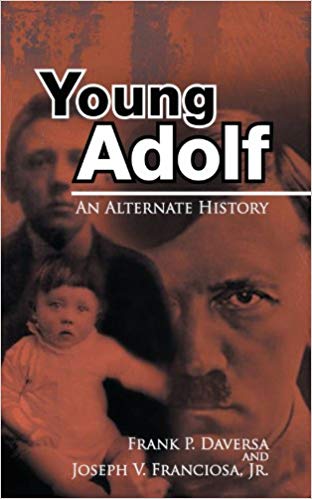
Synopsis
Young Adolf as you have never seen him before . . . Experience Adolf Hitler's childhood in striking detail. Witness his ordeals, from the rigors of his schooling to beatings by his father. Factual accounts are interspersed with fictional inventions, such as his relationship with a hypothetical girl named Helga. Can young Adolf conquer the personal barriers his difficult childhood presented and become close with her emotionally? How will that change him? Learn more about Adolf the boy. Experience the molding of his dreams, his prejudices, and his desires in visceral detail. Come to understand the inner-workings of History's most infamous megalomaniac through the perspective of a child's eyes. Follow Adolf from birth to his late teenage years. Know the boy before he was the world's most feared man. Decide for yourself if Helga's influence might have altered the course of History.
- Details
- Written by Super User
YOUNG, MATILDA JANE FULLER (1826–1882). Matilda Jane (Maud Jeannie) Fuller Young, writer and botanist, was born on November 1, 1826, in Beaufort, North Carolina, the oldest child of Nathan and Charlotte M. Fuller. About 1839 the family moved to Sumter County, Alabama, and by 1843 they had located in Houston. Nathan Fuller served as mayor of Houston in 1853–54 and later worked as a railroad paymaster. Maud married Dr. Samuel O. Young, a native of Charleston, South Carolina, in Houston on February 8, 1847. He died nine months later, on November 10. The young widow lived with her family for the rest of her life. A son, born on January 1, 1848, and named for his father, became a doctor and practiced in Houston from 1870 to 1880, when he became associate editor of the new Houston Post. Maud wrote poems, fiction, and essays that appeared in the Houston Telegraph between 1856 and 1867 and also in various magazines. Her poem about the Texas Rangersqv was published anonymously in William Gilmore Simms's War Poetry of the South(1867). Her longest fictional works were Cordova: A Legend of Lone Lake, a religious novel, and The Legend of Sour Lake, a prose poem about the Confederacy and the ancient Indian campsite northeast of Beaumont, both published before 1870. In 1880 she wrote articles for the Houston Post under the name Patsy Pry. Other work appears in Ella Hutchins Steuart's Gems from a Texas Quarry (1885).
During the Civil War Mrs. Young, who was related to Confederate general Braxton Bragg, composed inspirational writings for Confederate soldiers, using as pen names "The Confederate Lady" and "The Soldier's Friend." In May 1862 she made a flag for her son's Company A, Fifth Regiment, Hood's Texas Brigade, which Hood designated the official flag of the brigade at the battle of Gettysburg. By the fall of 1864 the flag had become so tattered that it was no longer fit for use, and the Fifth Regiment returned it to Young, asking her to be its custodian. The flag was presented to the state during a reunion of the brigade in 1926. Young also nursed in hospitals and collected clothing and money in support of the war effort. After the surrender of Robert E. Lee, appeals by Young (who signed herself "A Confederate Woman") and generals Edmund Kirby Smith, John Bankhead Magruder, and Joseph O. Shelby were printed together in a broadside entitled "To the Soldiers and Citizens of Texas, New Mexico and Arizona," which urged continued resistance on behalf of the Confederate cause. When the Hood's Brigade Association was organized in 1872, the group's first resolution hailed Young as the "Mother of Hood's Brigade." In the 1870s she was appointed by a board in Philadelphia to serve as the Texas member of the Women's Centennial Executive Committee, and in this capacity she worked to coordinate fund-raising for the Centennial among Texas women.
Though she was largely self-taught, Maud Young had a reading knowledge of Latin, Greek, German, and French and a deep interest in botany. She taught at the private Houston Academy from 1866 to 1869, but with the opening of the public schools in 1870 the academy fell on hard times and closed. She opened a private school in 1872 in the Old Jewish Synagogue. She may also have taught in the public schools. In addition to her poems and stories, she also wrote on natural history topics. Her article on singing mice appeared in Field and Forest (1876–77), and an article on "Forest Culture," urging conservation, research, tree planting, forest clubs, and the passage of a forest law, was published in the 1880 edition of Burke's Texas Almanac. Young also authored the first textbook on Texas botany, Familiar Lessons in Botany, with Flora of Texas (1873.) She was state botanist in 1872–73. Her herbarium of Texas ferns and flowering plants, as well as a collection of her writings, was lost in the Galveston hurricane of 1900. At that time the collection was probably in the possession of her son, a Galveston resident. Maud Young died on April 15, 1882, and was buried at Glenwood Cemetery in Houston.
Elizabeth Brooks, Prominent Women of Texas (Akron, Ohio: Werner, 1896). Confederate Veteran, July 1900, March 1903. Dallas Weekly Herald, May 29, 1875. S. W. Geiser, "Men of Science in Texas, 1820–1880," Field and Laboratory 26–27 (July-October 1958-October 1959). Ida Raymond, Southland Writers: Biographical and Critical Sketches of the Living Female Writers of the South(2 vols., Philadelphia: Claxton, Remsen and Haffelfinger, 1870). R. A. Studhalter, "Mrs. Young's Familiar Lessons in Botany," Texas Technological College Bulletin 7 (December 1931). Vertical Files; Maud J. Young Papers (Dolph Briscoe Center for American History, University of Texas at Austin).
Citation
The following, adapted from the Chicago Manual of Style, 15th edition, is the preferred citation for this article.
William E. Bard, "ADAMS, WALTER R.," Handbook of Texas Online (http://www.tshaonline.org/handbook/online/articles/fad08), accessed March 19, 2015. Uploaded on June 9, 2010. Published by the Texas State Historical Association.
- Details
- Written by Super User
YOUNG, STARK (1881–1963). Stark Young, man of letters and painter, son of Alfred Alexander and Mary Clark (Starks) Young, was born at Como, Mississippi, on October 11, 1881. His father was a Civil Warveteran and a prominent physician in Como and Oxford. Young's mother, a member of the wealthy planter family of McGehees, died when Young was eight years old. He was reared for the most part by his mother's maiden sisters and his uncle Hugh McGehee. From these antecedents he received the traditional values and southern point of view that became features of his writings. In 1895 Alfred Alexander Young married again and moved Stark and his sister, Julia, to Oxford, Mississippi. After receiving his education in the classics and languages at the University of Mississippi (B.A., 1901) and at Columbia University (M.A., 1902), Young taught English literature at the University of Mississippi (1905–07), the University of Texas (1907–15), and Amherst College (1915–21). At the University of Texas he helped to found the Curtain Club, one of the first successful little theater groups in the United States. Young directed its plays, coached its student actors, and translated foreign plays for its productions. At the same time, he was a popular teacher and lecturer. In 1912 he published Addio, Madretto and Other Plays, and in 1915 he founded the Texas Reviewqv, a journal devoted to the arts and humanities. During Young's tenure at the University of Texas, his sister came to live with him. In 1914 she married John Benjamin Robertson, and after a brief period in San Antonio the Robertsons made their home permanently in Austin. After Young moved away from Austin, he returned to spend many holidays and summers with the Robertsons. He was deeply attached to them and to the area, which became the setting for a number of his stories and sketches. From 1915 to 1921 Young taught English literature at Amherst College. During these years his essays on various subjects, including the theatre, began to appear in such periodicals as the New Republic, the Nation, the North American Review, the Yale Review, and Theatre Arts Magazine. After a year of writing in Spain, Young resigned from Amherst and moved to New York City, his home for the remainder of his life. There he soon became a member of the editorial board of both the New Republic and Theatre Arts Magazine. To these periodicals he contributed hundreds of articles, mainly dealing with the theater. Except for a brief period (1924–25), when he served as drama critic for the New York Times, Young remained associated with the New Republic until 1947, when he retired. In the 1920s and 1930s, the years of his most productive work, Young published a series of books on drama containing essays based largely upon his reviews of New York productions and written for the New Republic and Theatre Arts Magazine. These volumes include The Flower in Drama (1923), Glamour (1925), Theater Practice (1926), and The Theater(1927). Later he collected the best of his drama reviews in Immortal Shadows (1948). These volumes established him as a leading drama critic in the country.
During these years Young also wrote several plays, including The Colonnade (1925) and The Saint (1925), that were staged with critical success; directed the Theatre Guild's New York production of Henri René Lenormand's The Failures, Eugene O' Neill's Welded, and Molière's George Dandin; and published four books of fiction. Young's novels, Heaven Trees (1926), The Torches Flare (1928), River House (1929), and So Red the Rose (1934), have a Mississippi background and contrast southern manners, ideas, and attitudes with northern ways of living. In So Red the Rose Young has written perhaps the finest novel of the Civil War seen from the southern point of view. The book became a bestseller and a popular motion picture and has remained in print ever since its initial publication. In 1930 Young wrote the concluding essay, "Not in Memoriam, but in Defense," for the southern agrarian manifesto I'll Take My Stand. In it Young argued the case for the southern way of life that he had already expressed in fiction.
Near the end of the 1930s Young translated Anton Chekhov's The Sea Gull for the immensely successful New York production starring Alfred Lunt and Lynn Fontanne. In succeeding years Young translated other Chekhov plays that were widely used in both little theater and professional performances. In 1956 Young's translations were collected and published in the Random House Modern Library series. In 1939 Young wrote a romantic comedy, first entitled Belle Isle and later Artemise, for the Lunts. After enthusiastically accepting the play, the Lunts failed to produce it, and in 1942 Young had it privately printed. Embittered by the Lunts' rejection of Artemise, the tragic death in 1936 of the Robertsons' only son, Young's namesake, Stark Young Robertson, during his freshman year at Yale, and what he saw as the decline of the American theater, Young resigned from the New Republic and Theatre Arts Magazine. As a relaxation he began to paint flowers and landscapes and had two one-man exhibitions in New York that were praised by critics. In 1951 Scribner's published his autobiography, The Pavilion. Young died in New York on January 6, 1963. Stark Young will be remembered primarily for his drama criticism and his Civil War novel, but his major contribution was to the arts in general. He devoted his life to the arts and belongs to the cultural history of America. Few have equalled his insight into the nature of art, and even fewer have surpassed his achievements. America has never had a drama critic quite like him; and until the theater enjoys another renaissance like the one in the 1920s and the 1930s, it may not see Young's equal.
John Pilkington, Stark Young (Boston: Twayne, 1985). John Pilkington, ed., Stark Young, A Life in the Arts: Letters, 1900–1962 (2 vols., Baton Rouge: Louisiana State University Press, 1975). Bedford Thurman, Stark Young: A Bibliography of His Writings with a Selective Index to His Criticism of the Arts (Ph.D. dissertation, Cornell University, 1954).
Citation
The following, adapted from the Chicago Manual of Style, 15th edition, is the preferred citation for this article.
William E. Bard, "ADAMS, WALTER R.," Handbook of Texas Online (http://www.tshaonline.org/handbook/online/articles/fad08), accessed March 19, 2015. Uploaded on June 9, 2010. Published by the Texas State Historical Association.